
Two days after the vote, Democrats hold at least 54 Senate seats and a House majority, with 228 House seats called for them by Wednesday morning (State Capital Lobbyist, citing AP). Seven Senate seats flipped: North Carolina, South Carolina, Texas, Ohio, Iowa, Kansas and Maine. Two more are still counting. In Mississippi, Scott Colom led Senator Cindy Hyde-Smith by 1,138 votes with 96% counted (TIME); in Alaska, Mary Peltola led Senator Dan Sullivan by 637 votes, with ranked-choice results due November 18 (Al Jazeera). The 120th Congress convenes January 3. President Trump keeps the veto pen through January 2029.
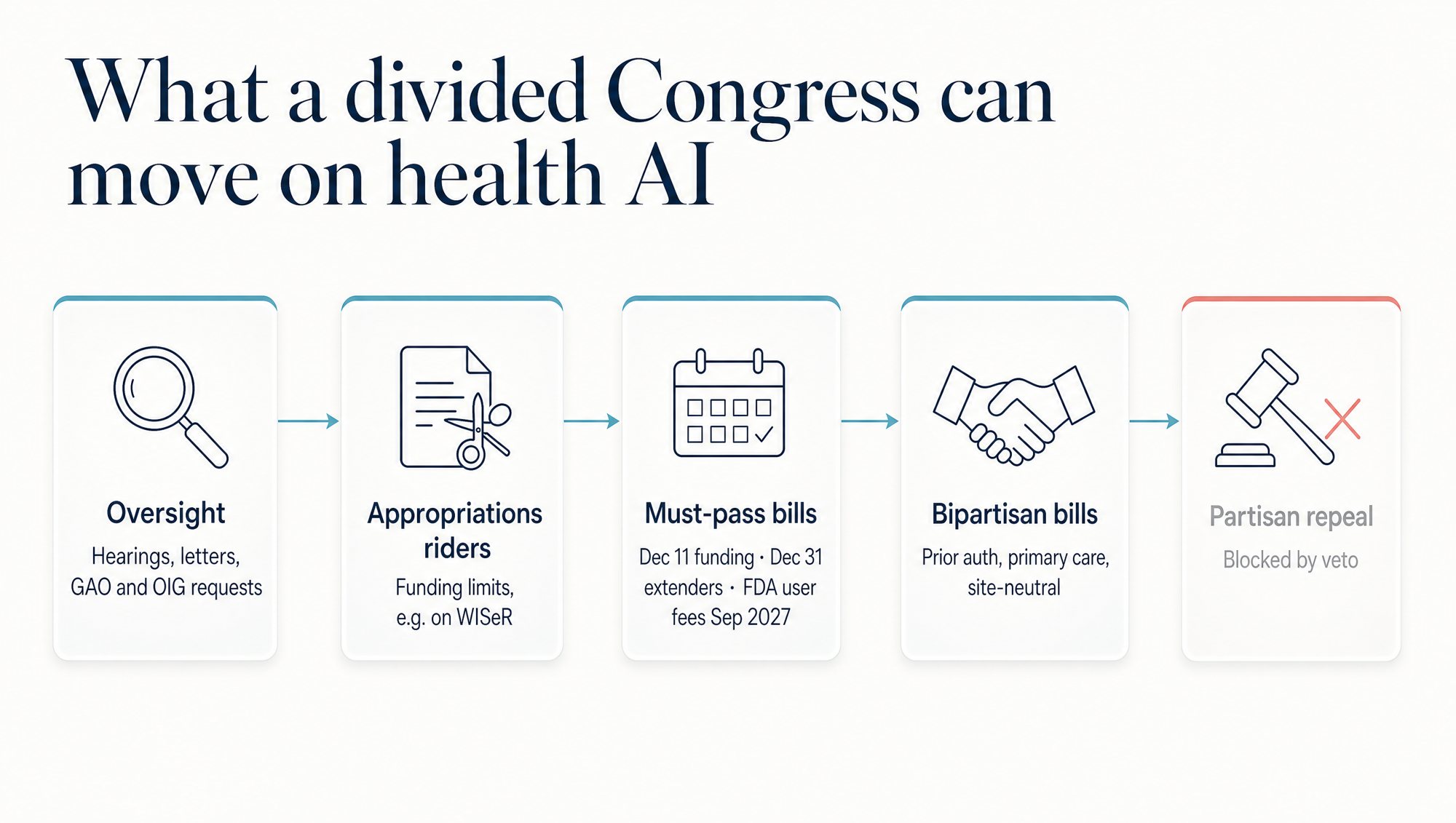
For health AI, the arithmetic matters more than the mood. Overriding a veto takes two-thirds of both chambers. A Democratic Congress cannot repeal the Medicaid provisions of the 2025 reconciliation law, restore the enhanced ACA tax credits over the President's objection, or enact a federal AI statute the White House opposes. It can investigate, attach riders to spending bills, bargain over must-pass deadlines, and pass the narrow bipartisan bills that already carry Republican cosponsors. Most health AI policy in 2027 will be written in CMS rules, CMMI models, state legislatures and federal courts.
That is my forecast. The rest of this piece is the reasoning, organized around the issues that carried the election (affordability, Medicaid, payer behavior) and the two that will outlast it: outcomes-based payment and a clinical labor supply that keeps shrinking relative to demand.
For paid members, I built a companion: an interactive map of how members of Congress have spoken and voted on health AI, data centers and AI preemption since 2023, with every entry dated and linked to its source.
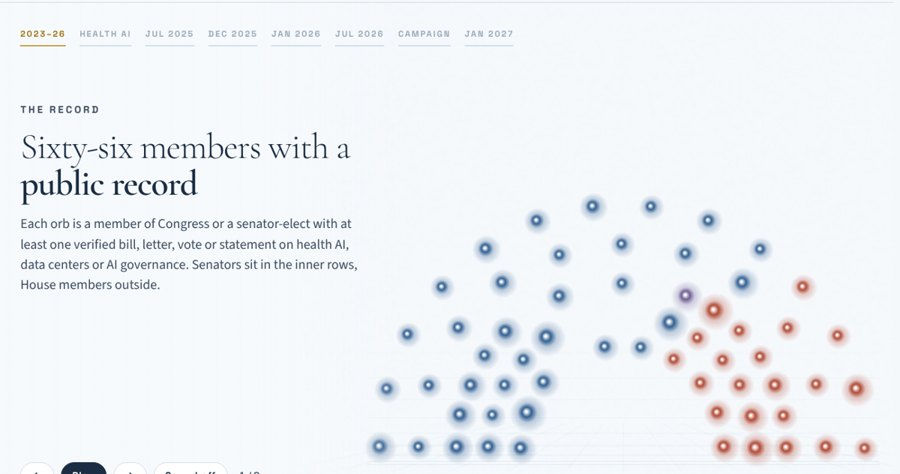 Members’ companionWhere Congress stands on health AI179 sourced records · 66 members · story, explorer and themes
Members
The rest of this briefing is for members
Sign in with the email on your Techy Surgeon membership and the page opens here.
Checking your membership…
The calendar a divided Congress inherits
Republicans run the lame duck. Government funding expires December 11, and a stack of health extenders lapses December 31: the one-year 2.5% Medicare physician fee bump, the $4.6 billion Community Health Center Fund, the National Health Service Corps, the Special Diabetes Programs, and the low-volume and Medicare-dependent hospital payments (Holland & Knight). Whatever health policy moves this year will ride the funding bill (STAT).
The 2027 calendar has two vehicles that matter for health AI. FDA user fee authority expires September 30, 2027, and user fee reauthorization is the likeliest statutory vehicle for changing how FDA reviews AI-enabled devices (Holland & Knight). Medicare telehealth flexibilities expire December 31, 2027; hospital-at-home runs through September 30, 2030 (McGuireWoods).
The Congressional Review Act gives Democrats less than it appears to. A CRA resolution cannot be filibustered, but it still needs a signature, and the President will not sign away his own administration's rules. Senator Wyden's resolution against WISeR, CMS's AI-assisted prior authorization model in traditional Medicare, already failed 46-50 in July (Becker's Payer). Appropriations riders are the stronger tool. The House Appropriations Committee, under Republican control, unanimously adopted a fiscal 2027 rider barring funds for WISeR or any model that adds prior authorization to traditional Medicare (Fierce Healthcare). A similar fiscal 2026 rider was dropped in conference (Georgetown CHIR). With Democrats writing the bills, I expect it back.
New gavels, familiar records
STAT reports Senator Wyden is expected to chair Finance and Senator Sanders is the presumptive HELP chair (STAT). Senator Cantwell, the ranking Democrat on Commerce, co-led the amendment with Senator Blackburn that stripped the 10-year state AI-law moratorium from the reconciliation bill on a 99-1 vote in July 2025, calling the compromise version "Section 230 on steroids" (Senate Commerce). In the House, Frank Pallone and Richard Neal are the ranking members on Energy and Commerce and Ways and Means; seniority points to them, though neither chairmanship is confirmed.
On health AI, the incoming chairs have already written their oversight playbook. Wyden convened Finance's 2024 hearing on AI in health care and said the protections in his Algorithmic Accountability Act "must apply to patients in Medicare and Medicaid" (Senate Finance). In May he led the resolution to overturn WISeR: "The last thing seniors need is even more AI denying the care they need" (Senate Finance). Cantwell co-led that resolution after writing Secretary Kennedy that she supports "the responsible use of new technologies, including artificial intelligence, to improve care delivery" (Sen. Cantwell). Pallone told a 2025 Energy and Commerce hearing that "without adequate oversight, these new technologies can lead to devastating consequences for patients" (Medical Economics). Sanders's AI record runs through labor and infrastructure: a HELP minority staff report warning AI could eliminate nearly 100 million jobs (Fox 9) and a data center moratorium bill with Representative Ocasio-Cortez (WCAX).
The outgoing Republican chairs set a different default. Cassidy's 2023 white paper argued that "a sweeping, one-size-fits-all approach for regulating AI will not work" (HELP Committee), and Crapo told the 2024 Finance hearing that Medicare coverage and payment must keep pace with AI devices (Sen. Crapo). Both will remain in the room as ranking members, and any health AI bill that reaches the President's desk will need them.
The records do not sort cleanly by party. Senator Hawley (R) wrote the GRID Act with Senator Blumenthal (D) to keep data-center load off household power bills, and the GUARD Act on AI companion chatbots and minors with Blumenthal, Warner, Murphy and Britt (NBC News; Sen. Hawley). Representatives Greg Murphy (R) and Herb Conaway (D) introduced the Protecting Patients from Automated Denials Act in July, which would require disclosure of AI in prior authorization and physician attestation on denials (Rep. Murphy). Senators Whitehouse (D) and Cassidy (R) introduced the Pay PCPs Act in August (Medical Economics). Senators Rounds (R) and Heinrich (D) wrote the Health Tech Investment Act to give FDA-authorized AI devices a Medicare payment pathway (Sen. Heinrich).
The line I see running through the map separates AI that withholds care from AI that adds capacity. The first draws suspicion from both caucuses. The second has allies in both.
Affordability sets the agenda
The enhanced ACA premium tax credits expired December 31, 2025. The Senate rejected both a Democratic three-year extension and a Republican HSA alternative, each 51-48, on December 11 (Becker's). The House passed a three-year extension 230-196 in January with 17 Republican votes, and Senate talks on a two-year version fizzled by February (Washington Times). Effectuated marketplace enrollment fell from 22.1 million to 19.2 million, and enrollees keeping the same plan paid 114% more in premiums (KFF). Benchmark premiums rose about 26% for 2026 and another 13% for 2027; CBO projects marketplace enrollment of 13.1 million next year (KFF).
Medicaid changes arrive on top of that. CBO estimates the reconciliation law leaves 10 million more people uninsured in 2034 (AHA). Work requirements and six-month redeterminations for expansion adults start January 1, 2027, under a CMS interim final rule issued in June (CMS). Voters noticed: in KFF's election poll, they trusted Democrats over Republicans on health care 49% to 30%, and 54% said the administration's policies had raised their own costs (KFF).
Repeal is off the table under a veto. Expect fights over implementation: targeted delays, appropriations limits and oversight of how states verify work hours (Holland & Knight). Verifying 80 hours of monthly work and re-checking eligibility every six months for millions of adults will run on state eligibility software. My expectation is that the automated eligibility systems states buy for this become the next oversight target, the way Medicare Advantage algorithms did.
Site-neutral payment is the rare cost issue with bipartisan backing. The CY2026 outpatient rule paid drug administration in off-campus hospital departments at the physician-office rate. The CY2027 outpatient rule, finalized November 4, extends that to imaging without contrast, an estimated $260 million in first-year Part B savings (CMS). Senator Kennedy's Same Care, Lower Cost Act goes further, at an estimated $150 billion over ten years (CRFB). The same rule renames software-as-a-service payment "Software as a Medical Service" and assigns those services to New Technology APCs as an interim step (CMS). New Technology APCs are a temporary placement. Where CMS moves those services next will do more to set the price of clinical AI than anything Congress votes on next year.
Payers under the lamp

Medicare Advantage insurers made 52.8 million prior authorization determinations in 2024 and denied 7.7%. Only 11.5% of denials were appealed, and 80.7% of those appeals were overturned (KFF). The Senate Permanent Subcommittee on Investigations found post-acute denial rates roughly three times the overall rate at UnitedHealthcare and CVS and more than 16 times at Humana (PSI). The class action over UnitedHealth's nH Predict algorithm survived on contract claims, and in March a federal court compelled discovery that reaches the company's internal AI review board (DistilINFO). Commercial coverage is no calmer: the average family premium reached $28,303 this year, with workers paying $7,471, up 9% (KFF).
Two deadlines arrive January 1, 2027: insurers' pledge to answer 80% of electronic prior authorization requests in real time (Fierce Healthcare), and CMS's prior authorization API requirements (CMS). A Finance Committee chaired by Wyden will measure insurers against both. Six in ten physicians already worry AI will increase denials (AMA). For anyone building AI that touches a coverage decision, I expect disclosure and clinician attestation to become the norm by some route, whether statute, CMS rule or state law.
Value-based payment outlasts the election

CMMI is a creature of the Affordable Care Act. A Democratic Congress will question its mandatory models; it will not dismantle them. The current slate is the most ambitious in the center's history. The ACCESS model went live July 1 with more than 150 organizations accepted (pulse.bot), and in September CMS added heart failure, COPD, substance use and nicotine dependence tracks for spring 2027 (AHA). The LEAD ACO model starts January 1 (Foley). CJR-X, the mandatory nationwide joint replacement bundle, starts January 2028 with $736 million in projected savings (Becker's).
Primary care and behavioral health payment keep moving in the same direction, and the final 2027 physician fee schedule released November 4 makes the direction explicit. The conversion factor falls 2.31% for most clinicians and 1.83% for qualifying APM participants, largely because the one-year 2.5% bump expires (CMS). Inside that cut, the G2211 add-on becomes a B1 modifier worth 16% of the visit, a new B2 modifier pays 32% more for clinicians in Shared Savings Program ACOs or the LEAD model, and collaborative care work values rise (CMS). The rule also creates payment pathways for health and well-being coaching and shared medical appointments, lets ACOs waive Part B cost sharing starting April 1, 2027, and sunsets traditional MIPS in 2031 (CMS). "For too long, fee-for-service payment has rewarded volume over value, fueling a reactive system of sick care," Administrator Oz said in the release. The Pay PCPs Act would add $10 billion in hybrid per-patient primary care payments outside budget neutrality.
I have a stake here: RevelAi participates in ACCESS on the musculoskeletal track. I have argued before that clinical AI pays for itself only when it does clinical work that someone pays for on outcomes, and I wrote an operator series on ACCESS and a guide to CJR-X. The election changes none of that math. If anything, a Congress focused on affordability will prefer payment that rewards results over payment that rewards volume, and the models above are where that preference has a budget.
The supply constraint does not change with the majority

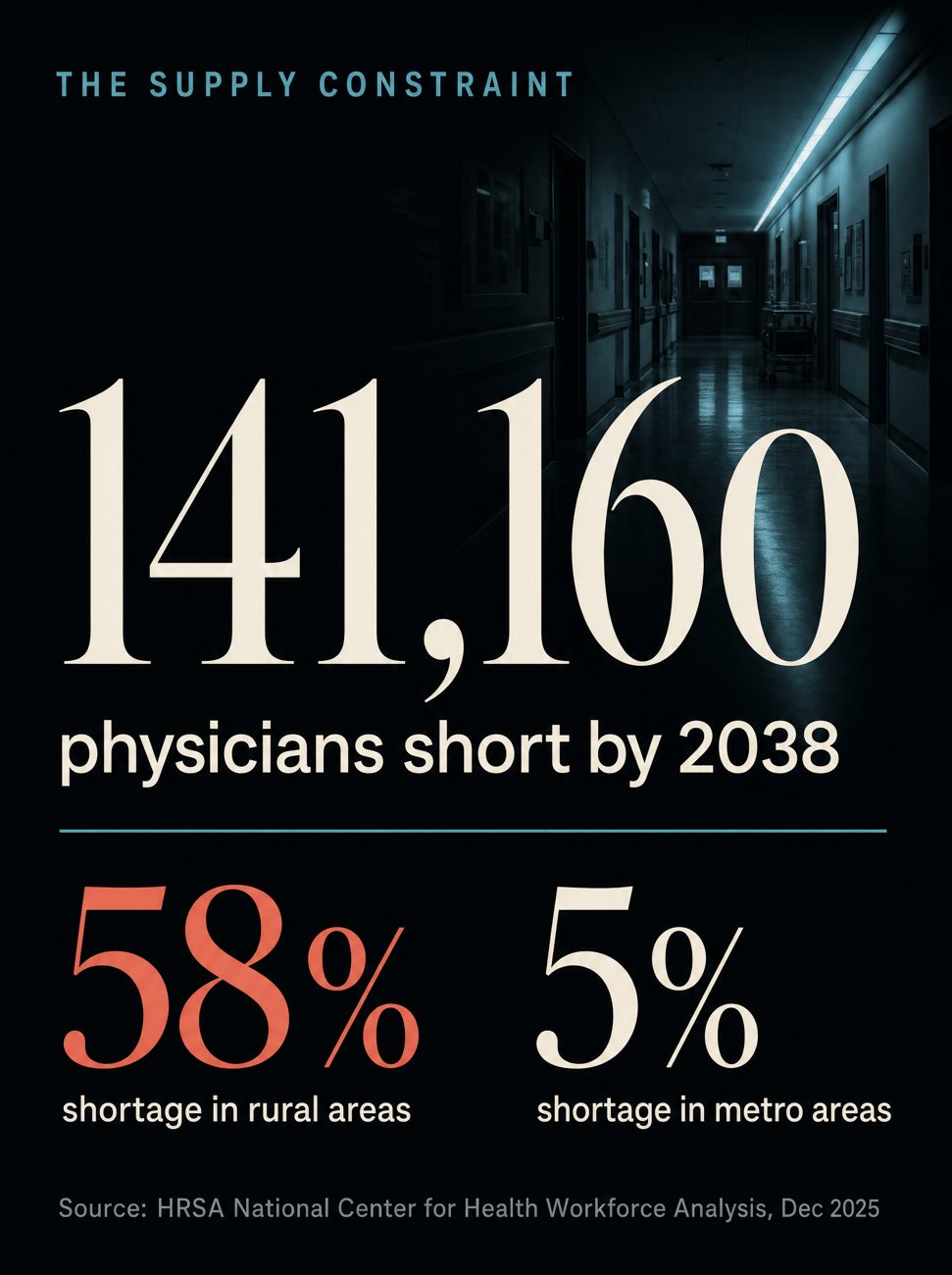
HRSA projects a shortage of 141,160 physicians in 2038. The gap is 58% in nonmetro areas and 5% in metro areas (HRSA). Adult psychiatry is projected at 50% of need (HRSA), and 157 million people live in mental health shortage areas where 26.5% of need is met (HRSA). Nursing schools turned away 92,672 qualified applications in 2025 for lack of faculty and clinical sites (AACN). PHI projects 9.7 million direct care job openings over the next decade (PHI), in a workforce where immigrants hold 30% of long-term care jobs (KFF).
The pipeline is narrowing at the same time. International medical graduates are 25.6% of active physicians, and 23.9% of physicians are 65 or older (AAMC). In the first Match under the $100,000 H-1B fee, the match rate for non-U.S.-citizen IMGs fell to 56.4%, a five-year low (NRMP). Federal courts have vacated the fee twice; DHS has proposed a $103,265 version by rule (Forbes). The bipartisan bill to add 14,000 Medicare residency slots has sat at introduction since last year.
Demand runs the other way. The population 85 and older is projected to more than double, from 6.5 million in 2022 to 13.7 million by 2040 (ACL), and 78.8% of adults 65 and older live with two or more chronic conditions (CDC). From where I stand in orthopaedic trauma, the number I watch is the nearly 319,000 older adults hospitalized for hip fractures each year (CDC). Every one of them needs bone health treatment, rehabilitation and fall prevention after discharge, and the people who deliver that follow-up are the ones in shortest supply.
No Congress will train its way out of this within a decade. AI with clinical oversight is one of the few levers that adds capacity on a policy timeline, and the evidence is real but uneven. Autonomous AI raised diabetic eye exam completion in young patients from 22% to 100% in a randomized trial at Johns Hopkins (Nature Communications). AI-supported mammography in Sweden cut radiologist reading workload 44% with fewer interval cancers (Lund University). Kaiser's deterioration alerts, reviewed by remote nurses before escalation, were associated with 16% lower mortality (Kaiser Permanente). The failures are just as instructive. In the best randomized trial of ambient scribes, one of two tools cut note time by 9.5% and notes occasionally carried clinically significant errors (NEJM AI). The Epic sepsis model missed 67% of sepsis cases in external validation (JAMA Internal Medicine, via HealthDay).
The guardrails that make the successes possible are consistent: a defined clinical task, a human escalation path, measured outcomes and monitoring after deployment. FDA's Digital Health Advisory Committee recommended exactly that for generative AI mental health devices last November (Orrick). Meanwhile, ONC's HTI-5 rule last month removed the model-card transparency requirements for decision support tools in certified EHRs (Holland & Knight). I expect that rollback to draw letters from the new committee chairs.
Power bills and preemption

General AI politics will set the terms for health AI, and those politics shifted toward the ratepayer this year. Gallup found 70% of Americans opposed a data center near them (Washington Times, on Gallup). Pew found half now say data centers are mostly bad for home energy costs (Pew). Nearly every Democrat who flipped a Senate seat on Tuesday ran on data center costs or siting: James Talarico proposed federal minimum standards and developer-funded interconnection (KSAT), Sherrod Brown called for ending Ohio's data center tax breaks (BG Independent), Roy Cooper said data centers should generate and pay for their own power (WSOC), and Annie Andrews, a pediatrician, called for a two-year pause in South Carolina (Live 5). Representative Pallone said in June, "I am in favor of a national AI data center moratorium" (House E&C Democrats). Senator Warner, also a Democrat, said a moratorium "simply means China is going to move quicker" (Axios).
Federal preemption of state AI law has failed three times: the 99-1 Senate vote in July 2025, the dropped NDAA language in December, and the stalled push behind the White House framework released in March (Roll Call; AP via Boston Globe). The December 2025 executive order directing a DOJ task force against state AI laws remains in force. With Democrats chairing Commerce and Energy and Commerce, I put the odds of a federal preemption statute in the 120th Congress low. Health AI companies should plan for the state patchwork to persist, and for courts to decide how far the executive order reaches.
What I expect, with confidence levels
No comprehensive federal health AI statute in 2027 or 2028. High confidence. Divided government and the preemption fight see to that.
AI in coverage decisions gets disclosure and clinician attestation requirements by some route. Moderate to high. The Murphy-Conaway bill is bipartisan and small enough to ride an extenders package; CMS and states can get there without it.
WISeR faces a funding rider in fiscal 2027 or 2028 appropriations. Moderate. The House committee vote was unanimous under Republican control.
CMS keeps building AI payment and value-based models; Congress scrutinizes and does not stop them. Moderate. Watch where CMS moves "Software as a Medical Service" out of its interim New Technology APC placement.
Federal preemption of state AI laws stalls. Moderate.
The workforce gap widens regardless of who holds the gavels. High. Capacity-adding AI with documented oversight will find sponsors in both caucuses; AI that withholds care will find critics in both.
I expect to spend 2027 building the way I have argued for: clinical AI that does defined work under a clinician's supervision, escalates to a human when it should, and gets paid when patients improve. I held that standard before Tuesday. A Congress with broad oversight power and little room to legislate will apply it to everyone in this field.
