Executive summary
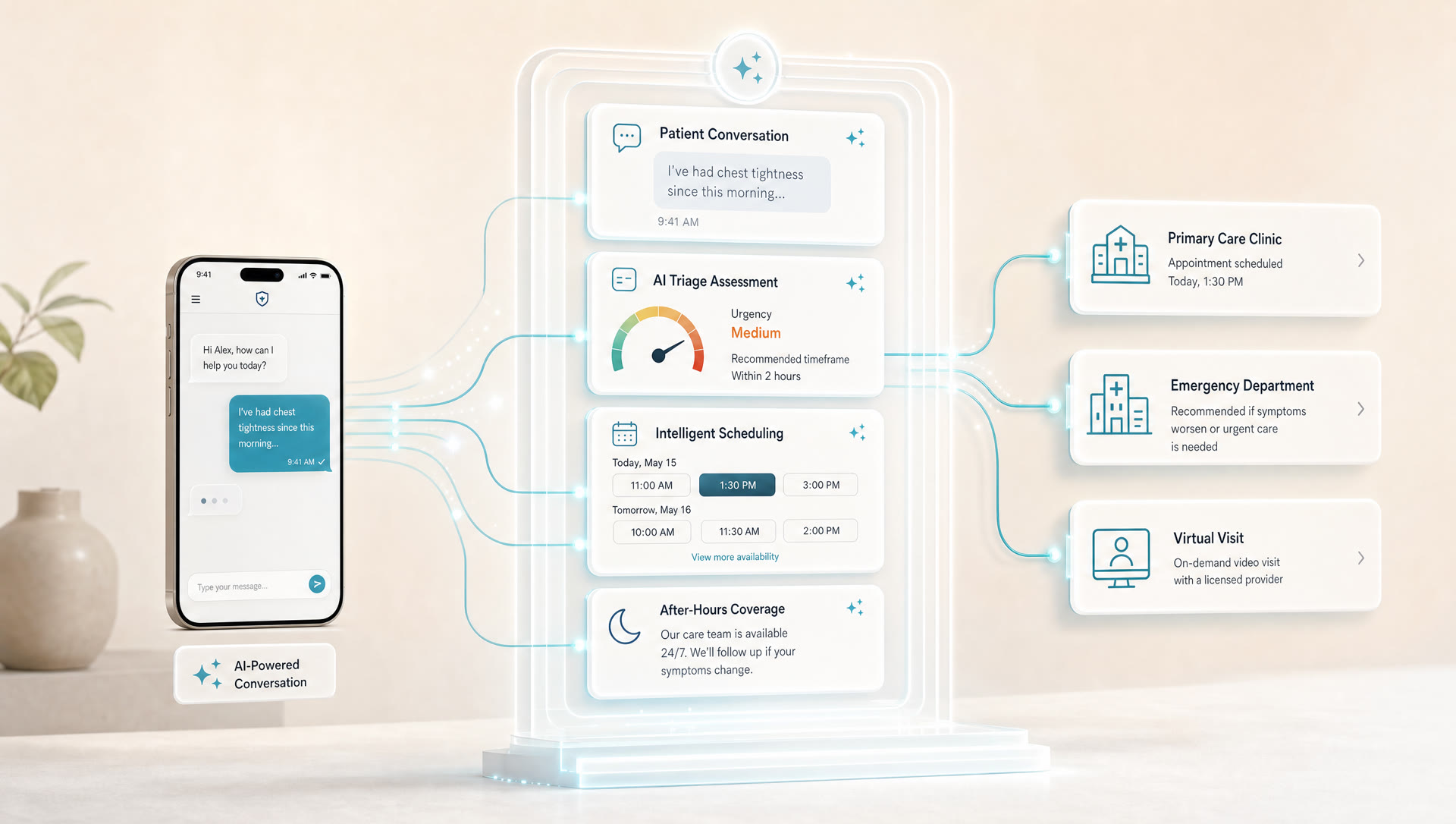
The front door of American health care is being rebuilt, and health systems are not holding the keys. The moment a person decides that something is wrong and begins to look for help now happens on a screen, and increasingly inside a conversation with an artificial intelligence the health system neither operates nor sees. Three forces have converged to move that moment upstream. Traditional primary care, the historical entry point, is in measurable structural decline: among commercially insured adults, primary care visits fell 24.2 percent from 2008 to 2016, and the share of adults with no primary care visit in a given year rose from 38.1 percent to 46.4 percent.40 Patients have filled the gap with self-service: of ChatGPT's roughly 800 million weekly users, about one in four, on the order of 200 million people, ask it health questions, and a nationally representative KFF poll fielded in early 2026 found that one in three adults had turned to an AI chatbot for health information.96 Technology and retail companies have spent tens of billions of dollars trying to own the new entry point, with mixed results that are themselves instructive.
The strategic consequence is direct. Whoever owns the intelligence layer at first contact owns discovery, triage, routing, and, over time, the longitudinal relationship. A health system that does not operate its own AI front door across discovery, triage, scheduling, navigation, after-hours contact, and follow-up will find that first contact defaulting to consumer chatbots, to platform players such as Amazon, or to third-party marketplaces. The clinical evidence makes the stakes concrete. Contemporary large language models are increasingly accurate on curated benchmarks, some now exceeding 90 percent diagnostic accuracy on clinical vignettes,21 yet they remain unsafe for unsupervised patient use: a structured stress test found that ChatGPT Health undertriaged 52 percent of gold-standard emergencies,2 and when real patients used otherwise high-scoring models, they identified the correct condition in fewer than 34.5 percent of cases, no better than controls.1
This paper argues that first contact is being disintermediated, quantifies the forces driving it, and gives operators a framework to respond. The central recommendation is a sequencing discipline: stabilize clinician capacity first with tools that already have strong evidence, then build or license an integrated AI triage layer that routes patients within the network rather than away from it, govern it for safety and equity before scaling, and treat the front door as owned, measured intelligence rather than a marketing channel. The systems that do this will convert the access crisis into captured demand. The systems that cede it will become the back office of care delivery.
The front door, redefined
The phrase "front door" has always been a metaphor for the set of decisions and surfaces that surround a patient's first contact with the health system. Historically that door was physical and narrow: a patient called a primary care office, waited on hold, booked an appointment weeks out, and was seen in a brick-and-mortar exam room. The interaction was a directory lookup followed by a phone tree. Its intelligence, such as it was, lived in the head of a scheduler or a triage nurse.
That door is being replaced by an interactive reasoning surface. The functions that define first contact have not changed: symptom interpretation, discovery of a provider or site, triage and routing to the right level of care, scheduling, navigation through a fragmented system, after-hours contact, and post-visit follow-up. What has changed is that each of these functions can now be performed, or at least attempted, by a large language model that a patient can reach at midnight from a phone. The front door has become a stack of software functions rather than a single physical portal, and that stack is contestable. It can be owned by the health system, partnered out to vendors, or ceded to consumer technology.
The question this paper addresses is therefore not whether AI will reach the front door — by every available measure it already has — but who will own first contact. That question is being resolved now, over the span of two or three product cycles, largely without the participation of the health systems whose patients are involved. The remainder of this paper examines the demand-side pressure pushing patients toward AI, the evidence on how they use it and where it fails, the consumerized decision journey that now precedes any clinical encounter, the supply-side reconfiguration that has reshaped who competes for the entry point, the economics of the opportunity, and the strategic choices available to operators.
The access deficit that pushes patients to self-serve
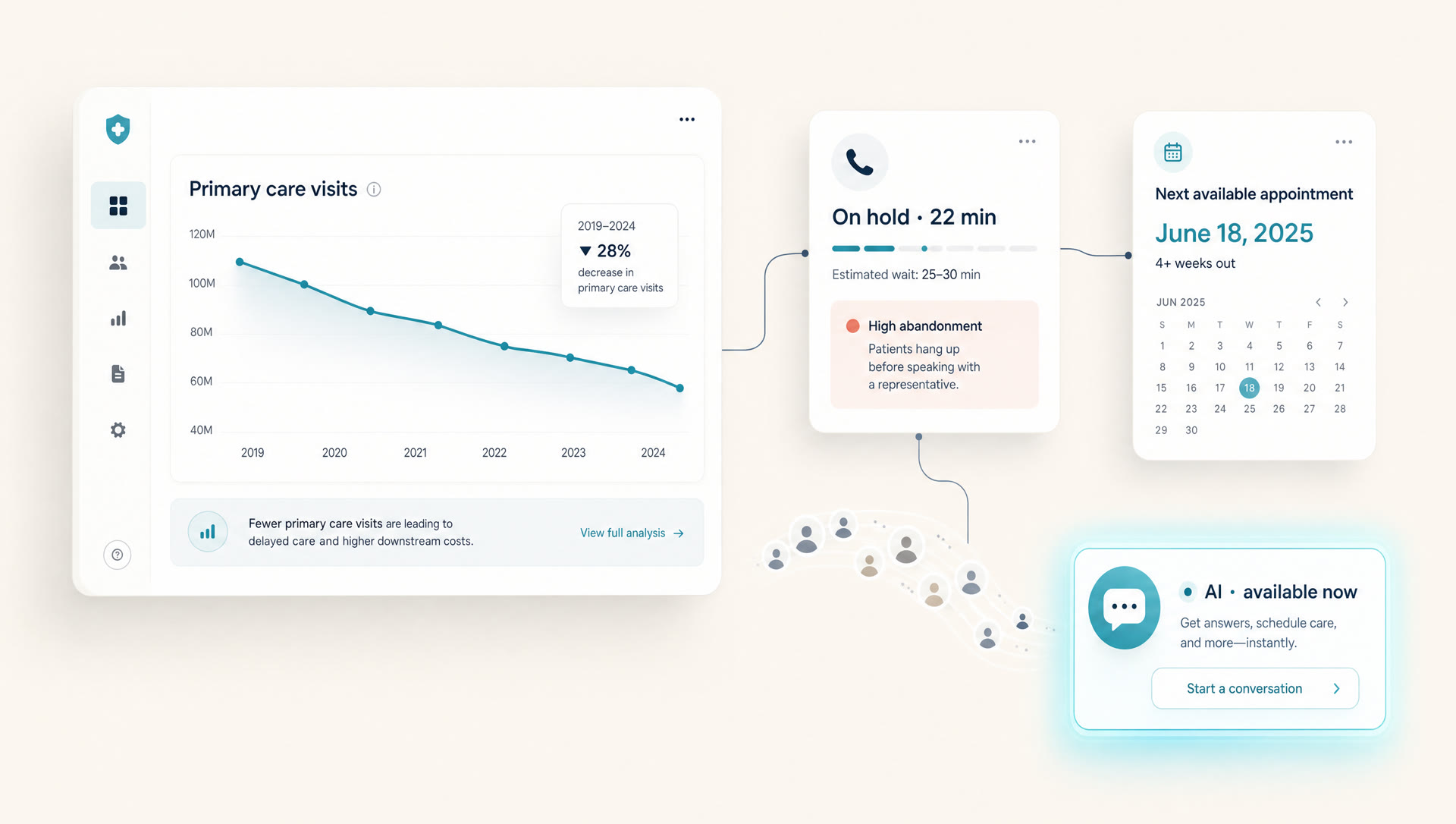
The decline of the traditional front door is not a pandemic artifact or a temporary backlog. It is a standing structural condition, visible across every major dataset and more than a decade of measurement.
Among commercially insured adults, primary care physician visits declined 24.2 percent between 2008 and 2016, from 169.5 to 134.3 visits per 100 member-years, while the proportion of adults with no primary care visit in a given year rose from 38.1 percent to 46.4 percent.40 Visits for low-acuity conditions, the traditional bread and butter of primary care, fell 47.7 percent over the same period.40,49 The pattern holds in public programs. Among traditional Medicare beneficiaries, primary care visit rates declined from 2.54 to 2.27 per person-year between 2017 and 2023, and the share of beneficiaries with at least one visit per year fell from 61.9 percent to 59.8 percent.20 Nationally representative MEPS data confirm a decrease in the rate of any primary care contact from 2002 to 2017.45
The visits that remain have grown more complex, running longer and addressing more diagnoses per encounter, but the volume decline is unambiguous.48 Meanwhile the relationship at the center of primary care is fragmenting. Person-based usual sources of care, meaning an ongoing relationship with an individual clinician, declined from roughly 27 percent to 15 percent between 1996 and 2014, while facility-based sources rose.16 The average Medicare patient now sees two primary care physicians and five specialists across four different practices in a year, and the share seeing five or more physicians rose from 17.5 percent to 30.1 percent between 2000 and 2019.42 This fragmentation is not benign. High care fragmentation is independently associated with more emergency department visits, more hospitalizations, departures from clinical best practice, and nearly double the health care spending in the highest versus lowest fragmentation quartiles.74-76
The supply side explains much of the pressure. Mean primary care physician supply fell from 46.6 to 41.4 per 100,000 population between 2005 and 2015, and hundreds of counties have no primary care physicians at all.77 HRSA projects a total physician shortage on the order of 187,000 by 2037, with primary care shortages most severe, and estimates that 76 million residents live in primary care health professional shortage areas.78,92 The AAMC projects a shortfall approaching 86,000 physicians by 2036.93 More than 100 million Americans report they lack a regular source of care.94 Primary care practices were less likely to offer extended or weekend hours in 2022 and 2023 than in the years just before the pandemic, and out-of-pocket costs for problem-based visits rose 31.5 percent from 2008 to 2016.40,48
The demand side compounds it. When a patient cannot get a timely appointment, cannot reach the office by phone, or cannot afford the visit, the rational response is to look elsewhere. Urgent care, retail clinics, and telemedicine absorbed much of this displaced demand: among commercially insured adults, visits to alternative venues rose 46.9 percent from 2008 to 2016,49 and by 2024, 27.6 percent of Americans had at least one urgent care visit and 19.0 percent at least one retail clinic visit in the prior year.50 The newest venue is a chatbot. An access deficit this large and this durable manufactures standing demand for any lower-friction front door, and an AI that answers instantly, at no marginal cost, at any hour, is the lowest-friction door yet built.
How patients are actually using AI for clinical reasons
Patient use of AI for health questions is mainstream, clinically consequential, and largely unsupervised. The scale of adoption is documented across multiple independent sources. Of ChatGPT's approximately 800 million weekly users, roughly one in four, on the order of 200 million people, seek health-related information, a signal strong enough that OpenAI launched a dedicated consumer health product, ChatGPT Health, in January 2026. A KFF Tracking Poll on Health Information and Trust, fielded in early 2026, found that one in three US adults had turned to an AI chatbot for health information in the past year, a share equal to those who use social media for the same purpose and up sharply from a 17 percent monthly-use baseline KFF measured in June 2024.96-98 A US cross-sectional survey found 21.5 percent of respondents had used ChatGPT specifically for health information, with 39.3 percent of those users doing so two to three times a week or more. Users skew younger, with a mean age of 32.8 versus 39.1 for non-users, have lower educational attainment on average, and make greater use of transient care settings such as emergency departments and urgent care.3
What patients do with these tools is clinically consequential. Among ChatGPT health users in one survey, 90.2 percent sought information about a health condition, 47.4 percent used it to decide whether a consultation was necessary, and 46.2 percent explored alternative treatments. Patients are not merely reading; they are acting. In the same study, 35.6 percent requested a referral based on ChatGPT information, 31 percent changed a medication, and 81 percent believed ChatGPT was as useful as or more useful than their doctor.12 The KFF work adds the motivation: cost and access barriers drive a meaningful share of this behavior, and patients frequently do not close the loop with a clinician afterward.96,99
The accuracy evidence is mixed and improving — a combination that supports neither dismissal nor uncritical adoption. A systematic review and meta-analysis of 60 studies found ChatGPT displayed an overall integrated accuracy of 56 percent in addressing medical queries.7 Physician-graded evaluations are more favorable: across 284 responses graded by 33 physicians spanning 17 specialties, ChatGPT achieved a median accuracy between "almost completely" and "completely correct," with GPT-4 outperforming GPT-3.5.9 In head-to-head comparisons of written responses to patient questions, chatbots frequently outscore physicians on quality and empathy,10 though these comparisons typically pit brief physician forum replies against much longer chatbot responses, and a systematic review of 20 such studies found results split, with 12 favoring the models, six mixed, and two favoring clinicians.17 Google's AMIE system, tested against 21 primary care physicians in a randomized blinded OSCE study, was non-inferior in management reasoning and scored better on treatment precision and guideline alignment. Contemporary models have reached diagnostic accuracy around 93.75 percent on clinical vignettes.21
The safety gap is where the operator's responsibility and opportunity both sit. A physician-led red-teaming study found problematic response rates ranging from 21.6 percent for one leading model to 43.2 percent for another, with unsafe response rates of 5 to 13 percent.25 A structured stress test of ChatGPT Health triage recommendations found that 52 percent of gold-standard emergencies were undertriaged, with diabetic ketoacidosis, for example, directed to a 24-to-48-hour evaluation window rather than the emergency department, and the system proved susceptible to anchoring bias, shifting toward less urgent recommendations when a hypothetical family member minimized symptoms.2 Patients cannot reliably catch these errors. In one study, specialists rated harmful ChatGPT responses significantly lower on usefulness and correctness, but patients showed no such discrimination.19 When tested with real human users, models that scored 94.9 percent on conditions in isolation led participants to identify the correct condition in fewer than 34.5 percent of cases, no better than a control group.1 This knowledge-practice gap, in which models achieve 84 to 90 percent on knowledge exams but only 45 to 69 percent on practice-based assessments,37 is the central unsolved problem of patient-facing deployment.
Trust dynamics complicate the picture further. A nationally representative US experiment found that disclosing AI involvement in a diagnosis consistently decreased patient trust and intention to seek help, with large effect sizes, a pattern consistent across age, gender, education, and political affiliation.35 Patients still prefer human expertise, and the aversion narrows only among frequent AI users. The synthesis for operators is precise: patients are using clinical AI at mainstream scale, often driven by cost and access, frequently without clinician follow-up, and they cannot themselves distinguish safe advice from dangerous advice. This constitutes both a patient-safety exposure and a market opportunity. An AI front door operated by the health system, governed for safety and connected to real clinical capacity, closes the loop that consumer tools leave open.
The consumerized decision journey
Even patients who never open a chatbot now begin their journey to care on a screen, and the structure of that journey has changed how patients select a point of entry. The discovery layer, the set of steps between deciding to seek care and booking an appointment, has become a consumer process that resembles how people choose a restaurant or a contractor more than how they once chose a doctor.
The evidence from the booking marketplaces is consistent. Zocdoc's 2025 What Patients Want report found that a positive personal connection ranks as the single most important factor in choosing a doctor, above ratings and above location, which tells operators that the discovery experience is emotional and relational even when it is digital. Patients now view an average of 21 provider profiles before selecting one, and 92 percent read a provider's bio before booking, up from 76 percent in 2018.100 Reviews have overtaken referrals: 61 percent of patients weight online reviews over personal recommendations,102 35 percent have chosen a provider based on social media, and 25 percent began using voice assistants to research providers in 2025.103 The funnel is digital from the first step, and the first step is increasingly a conversation with an AI rather than a search box.
The most operationally damaging finding concerns the phone. A quarter of patients say they hate calling a doctor's office. Roughly half report they could not reach their doctor by phone and delayed care as a result, and about a third abandoned a booking after failing to reach the office.104 Every one of those is displaced demand, a patient who wanted care from the system and did not get it because the front door was a phone line. The access center, staffed and expensive, is actively shedding the demand it exists to capture.
Two facts anchor the interpretation. First, delivery remains overwhelmingly in person: 93 percent of non-mental-health appointments were booked for in-person visits in 2025, including 92 percent among Gen Z, and 92 percent of patients stayed in network amid cost concern.100,101 Telehealth, after surging to 35.3 percent of primary care visits in the second quarter of 2020, stabilized at a modest baseline, around 6.6 percent of Medicare primary care visits in 2023 and 4 to 6 percent at large academic systems.20,57,58 Second, the discovery and access layer around that in-person delivery has been thoroughly digitized and is now being intermediated by AI. The contest is not for the exam room, which remains theirs, but for the discovery and routing layer that decides which exam room the patient reaches, and whether it is inside the system at all.
The retail retreat and the platform ascent
The supply side of the front door has been reshaped by an expensive natural experiment. Over the past three years, two theories of how to own primary care collided, and the results are now clear enough to guide strategy.
The first theory was that retail real estate and foot traffic could be converted into primary care relationships. It failed on unit economics. Walmart closed all 51 of its Walmart Health centers and its virtual care business in 2024.105,106 Walgreens closed roughly 160 VillageMD clinics, about half the footprint, after a write-down measured in billions on an investment of comparable size.105 CVS closed dozens of MinuteClinics even as it pursued value-based care through its acquisitions of Oak Street Health and Signify Health.105,107 The common cause was structural: retail labor costs, thin and uncertain reimbursement, and real-estate overhead ran against panels that filled slowly, and the retail-adjacency thesis, that a shopper buying groceries would convert into a primary care patient, did not hold at the margins required. Babylon Health, a digital-first entrant that showed lower acute hospital costs in some settings, nonetheless failed on unsustainable financing, a cautionary parallel for anyone assuming that a better care model guarantees a viable business.
The retail retreat
- Walmart Health: all 51 centers and virtual care closed, 2024
- Walgreens / VillageMD: ~160 clinics closed — about half the footprint — after a multibillion-dollar write-down
- CVS: dozens of MinuteClinics closed even while buying Oak Street and Signify
- Babylon Health: promising care model, unsustainable financing
The platform ascent
- Amazon × One Medical: acquired for $3.9B, closed 2023
- Prime bundling: membership at $9/month or $99/year — care as a consumer subscription
- Partner posture: arrangements with Cleveland Clinic, Hartford HealthCare, VMFH, Hackensack Meridian, Montefiore, Rush
- Jan 2026: AI health tool layered onto One Medical — the platform annexing the AI front door
The second theory scaled. Amazon acquired One Medical for 3.9 billion dollars, closing in 2023, and bundled membership into Prime at nine dollars a month or ninety-nine dollars a year, positioning a primary care membership as a consumer subscription rather than a clinical relationship.108,111 The membership-plus-platform model then repositioned from competitor to partner: One Medical established arrangements with health systems including Cleveland Clinic, Hartford HealthCare, Virginia Mason Franciscan under CommonSpirit, Hackensack Meridian, Montefiore, and Rush University System, with systems citing access and shifting patient expectations as the durable rationale.109 In January 2026, Amazon layered an AI health-care tool onto One Medical for members and added pay-per-visit and pediatric telehealth options.110 The move is best read as the platform annexing the AI front door: a company that already sits inside tens of millions of households through Prime is now placing an AI intelligence layer in front of, and alongside, the health systems it partners with.
The AI front-door product landscape
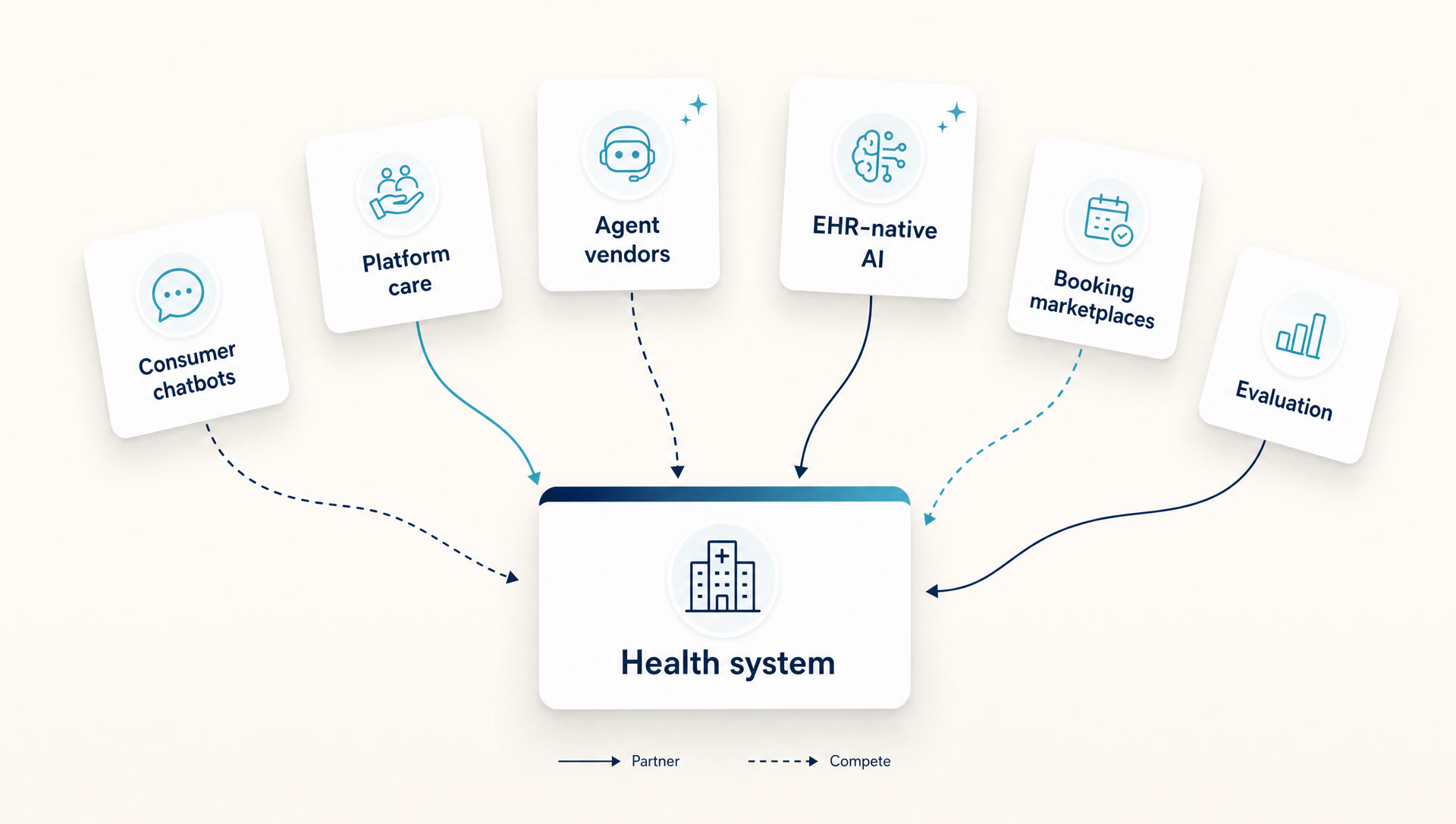
The vendors now occupying the front door fall into recognizable categories, each with a distinct buyer, a distinct job to be done, and a distinct threat or opportunity for a health system. An operator who cannot name the categories cannot make deliberate own, partner, or cede decisions across them.
Ambient consumer chatbots
ChatGPT, Gemini, Claude. Patients bring their own AI to every clinical question — 200M weekly health queries. No system can own this layer.
InfluencePlatform & retail care
Amazon One Medical dominates after the retail wind-downs. Convenient membership access — and disintermediation of the longitudinal relationship.
Partner — carefullyPatient-facing agent vendors
Hippocratic AI ($126M Series C at $3.5B, Nov 2025) licenses governed AI labor for the system's own front door. Non-diagnostic safety posture.
PartnerClinician-facing & EHR-native
Deepest adoption, strongest evidence: 31.5% of hospitals used EHR-integrated genAI by 2024; 62.6% of Epic hospitals adopted ambient documentation by mid-2025.
Build on firstDiscovery & booking marketplaces
Zocdoc, Healthgrades own the consumer discovery layer — reputation and scheduling bundled into a single surface. Rent, or own?
Rent vs. ownIndependent evaluation
PHTI and ICER methodology — the what-works-and-what-is-worth-it discipline. Belongs in every procurement conversation.
AdoptAmbient consumer chatbots are the default front door and the one systems control least. ChatGPT, Google Gemini, and Anthropic Claude reach patients directly, and patients bring their own AI to every clinical question. This is the surface behind the 200 million weekly health queries and the one-in-three adoption figure. No health system can own this layer; the realistic posture is to influence it through content, integration, and patient education rather than to compete with it head-on.
Platform and retail-adjacent care is dominated now by Amazon One Medical, with the wind-down of Walmart Health and the retrenchment of Walgreens and VillageMD as the counter-examples. The buyer here is the consumer, often through an employer or a Prime subscription, and the job to be done is convenient membership-based access. The strategic threat is disintermediation of the longitudinal relationship; the opportunity is partnership that extends a system's access without ceding its specialty and acute franchises.
Patient-facing conversational agent vendors build the infrastructure a health system can license to operate its own front door. Hippocratic AI is the category reference, having raised a 126 million dollar Series C at a 3.5 billion dollar valuation in November 2025 to expand patient-facing agents, with named health-system deployments and a deliberately non-diagnostic safety posture.112,113 One health system rated a post-discharge engagement program built on these agents at 9.0 out of 10 by patients.114,115 The buyer is the health system itself, the job is to staff the front door with governed AI labor, and the reimbursement logic runs through labor substitution and capacity expansion rather than fee-for-service billing.
Clinician-facing and EHR-native front-door features are where adoption is deepest and evidence strongest. A national AHA survey found 31.5 percent of US hospitals were using generative AI integrated with their EHR by 2024, with another 24.7 percent planning to within a year,44 and among Epic-using hospitals, 62.6 percent had adopted ambient AI documentation by mid-2025.84 Epic has emerged as the most influential single force in health-system AI adoption: hospitals on Epic were far likelier to be early adopters than those on other EHRs,44,46 and Epic has integrated large language models for patient message drafting at Stanford, UC San Diego, University of Colorado, and NYU Langone. Microsoft and Nuance, through DAX Copilot, lead the ambient documentation market, with clinical evidence showing reductions in physician task load and burnout. Google's health AI, the most extensively documented in the medical literature, spans Med-PaLM 2, Gemini, and AMIE. For most operators, the EHR vendor is the platform on which a front-door strategy should be built before standalone tools are considered.
Discovery and booking marketplaces such as Zocdoc and Healthgrades own the consumer discovery layer described in Section 4, and their reviews-plus-booking partnerships increasingly bundle reputation and scheduling into a single surface. The buyer is often the individual practice or system paying for visibility; the job is demand generation; the strategic question is how much of the discovery relationship a system is willing to rent versus own.
Independent evaluation infrastructure is the operator's lens on all of the above. The Peterson Health Technology Institute and its use of ICER methodology provide an assessment framework for digital health technologies, and PHTI's AI Taskforce offers a what-works-and-what-is-worth-it discipline. This is a governance category rather than a vendor one, and it belongs in every procurement conversation as the counterweight to vendor-reported outcomes.116-118
The central observation from this map: patients arrive through surfaces the system does not control, and several of the best-capitalized entrants are consumer technology companies for whom health care is one vertical among many. That is the strategic problem the rest of this paper works to solve.
The health economics of the AI front door
The front door is a profit-and-loss decision and a risk-economics decision, and it should be modeled as one rather than adopted as a marketing channel. The market context is large and fast-moving. The global AI-in-health-care market is projected to exceed 187 billion dollars by 2030, growing at a compound annual rate near 37 percent from about 15 billion in 2022. The US telehealth market rose to 17.9 billion dollars in 2020 and is projected to reach 140.7 billion by 2030. The FDA had authorized roughly 1,000 AI-enabled medical devices by mid-2024, up from near zero a decade earlier. These figures describe momentum, not proof of return, and the operator's task is to separate the two.
The most cited savings estimate, from a Harvard and McKinsey analysis referenced by Wachter and Brynjolfsson in JAMA, projects that AI could save 5 to 10 percent of US health-care spending, on the order of 200 to 360 billion dollars a year in 2019 dollars, primarily by reducing administrative waste rather than by making diagnoses. Administrative complexity is the single largest source of waste, and administrative simplification is where AI is most clearly feasible. The same authors caution that AI could accelerate waste if payers and providers enter an arms race, with models streamlining denials on one side and appeals on the other. On the payer side, AI has increased the share of complex claims processed without denial from below 80 percent to above 90 percent and cut associated administrative spending by roughly 30 percent, though only about 21 percent of prior authorizations are currently automated, and the same tools have been implicated in rising Medicare Advantage denial rates, which is why prior authorization is now the most common target of state AI legislation.
Inputs — the visible status quo
Levers — how the AI front door acts
Outcomes — what the P&L sees
For the front door specifically, the return should be built as a driver tree rather than reduced to a single number. The inputs are the visible costs of the status quo: access-center labor, phone abandonment, no-shows, referral leakage, and unmet demand that never converts to a visit. The levers are the mechanisms by which an AI front door acts on those inputs: labor substitution and augmentation in the access center, conversion of previously unmet demand into scheduled visits, in-network capture that reduces leakage, reduction of no-shows and avoidable emergency department use, and after-hours coverage without proportional staffing. The outcomes are cost-to-serve per contact, net new revenue from captured demand, and alignment with risk-bearing economics. Several nodes in that tree require benchmarks a system must source from its own operations, and the honest ROI model marks those nodes rather than papering over them with vendor averages.
The evidence on adjacent economics is encouraging but immature, and operators should read it with discipline. A large real-world study of 366,195 members found virtual-first care episodes cost 9 to 33 percent less than in-person-first care for common acute conditions.65 Yet a rigorous 2026 review of 117 health-economic evaluations of AI found that 63 percent assessed tools at early development stages, only 28 percent included implementation costs, and only 57 percent reported operational costs, and an earlier review found that 98 percent of studies concluded AI was cost-effective or cost-saving, a result so uniform that it more plausibly reflects publication bias and incomplete cost accounting than settled truth. This is exactly why the ICER and PHTI evaluation logic belongs at the center of procurement: treat clinical benefit and economic impact as the primary domains, treat user experience, equity, privacy, and security as modifiers, stratify by patient-risk tier, and buy on independent evidence rather than on vendor-reported outcomes. The front door is a P&L decision, modelable node by node, and the discipline of the model is what separates a defensible investment from an expensive experiment.
A strategic framework for health-system operators
The convergence of declining primary care access, mainstream patient AI use, and aggressive entry by technology companies poses a single question to every health-system operator: will the AI front door route patients into your system, or away from it? The framework below is built to answer it in practice rather than in principle.
Start from the disintermediation thesis as a risk, not a slogan. First contact is moving to surfaces the system does not control. That is a demand-funnel risk, a routing risk, and, over time, a relationship risk. Naming it as a strategic risk, with an owner and a budget, is the precondition for acting on it.
Assess where you stand with a front-door maturity model. Most systems can locate themselves on a five-level scale. The point of the model is to make the current state legible and the next step concrete, not to reach Level 4 everywhere at once.
Phone tree
A phone tree and a static directory.
Digital basics
Online scheduling and portal messaging.
AI-assisted
AI-assisted messaging and asynchronous triage.
Integrated AI front door
Operating across all six functions: discovery, triage, scheduling & routing, navigation, after-hours, follow-up.
Owned, measured intelligence
First contact instrumented with the same rigor as a clinical service line.
Decide own, partner, or cede function by function. Not every function should be built in house, and not every function can be safely ceded. Triage safety, routing logic, and navigation into owned assets are functions a system should own, because they determine clinical safety and in-network capture. Agent infrastructure and discovery marketplaces are natural partnership candidates, where licensing a governed platform beats building one. Ambient consumer chatbots are the function a system will most often have to cede in the sense that it cannot control them, and the correct response is to influence them through content and integration rather than to pretend they can be owned.
Discovery
PartnerTriage
OwnScheduling & routing
OwnNavigation
OwnAfter-hours
PartnerFollow-up
PartnerSequence the investment against the evidence. The strongest evidence in all of health-care AI concerns clinician-facing tools rather than patient-facing ones. A five-site JAMA study found ambient AI documentation was associated with 13.4 fewer minutes of total EHR time and 16.0 fewer minutes of documentation time per eight hours of scheduled care, plus 0.49 additional weekly visits and an estimated additional 167 dollars per month in E/M revenue per clinician. The first randomized trial of ambient scribes found significant reductions in time-in-note and burnout, and a six-system study found burnout fell from 51.9 percent to 38.8 percent after 30 days of use. The sequencing discipline follows directly: stabilize clinician capacity first, reaching high adoption of ambient documentation and AI-assisted inbox management, because capacity is the prerequisite for any front-door strategy, then build the patient-facing triage layer on top of a workforce that is no longer at the edge of burnout.
Own the integrated triage layer, because the outcome data favor integration. Integrated telemedicine, delivered within a patient's own system by their own clinicians, consistently produces better outcomes than direct-to-consumer alternatives: lower antibiotic prescribing, comparable safety, and higher follow-up rates.66,70,71 Virtual visits with an outside physician are associated with three times the risk of a seven-day emergency department visit compared with visits to a patient's own physician.68 A system that licenses or builds AI-powered symptom assessment and triage, and routes patients to the right level of care inside its own network, captures both the clinical benefit and the downstream volume. A system that cedes triage to a consumer app exports both.
Run a 90-day and 12-month playbook with named owners.
What gets measured at the front door is what gets owned. Measure first-contact resolution and containment, escalation accuracy and clinical-safety monitoring, access lag, phone abandonment, conversion of unmet demand, in-network capture and leakage, no-show and avoidable-ED rates, cost-to-serve per contact, and patient-reported experience.
First 90 days
- Stand up an AI governance committee
- Reach high adoption of ambient documentation among eligible clinicians
- Instrument the access center: phone abandonment, unmet demand
- Pilot AI-assisted patient messaging on a bounded service line
First 12 months
- Deploy integrated triage + scheduling across defined high-volume access points
- Connect the layer to after-hours coverage
- Establish the KPI dashboard that will govern it
- Monitor outcomes by race, ethnicity, and socioeconomic status
Risks, governance, and the equity and safety mandate
An owned AI front door is a safety instrument or a liability, depending entirely on how it is governed. The risks are concrete and the governance tools now exist, which means the operator's obligation is execution rather than invention.
The safety gap is the first mandate. Because roughly half of patients who use consumer AI for health do not follow up with a clinician,99 and because patients cannot themselves distinguish safe advice from dangerous advice, the value of an owned front door lies precisely in closing that loop: escalating appropriately, monitoring for the undertriage failure modes documented in ChatGPT Health,2 and routing to real capacity. The non-diagnostic boundary that leading vendors maintain is not timidity; it is the current standard of care for patient-facing agents, and it should be a procurement requirement rather than a nice-to-have.
Privacy and data governance are the second. Patients are uploading test results and clinical notes to tools that are not HIPAA compliant, and there are insufficient legal guardrails around that data. A system that offers a governed alternative, with clear consent and data handling, competes on trust as much as on convenience. Neither ChatGPT Health nor other consumer models are HIPAA compliant, and operators should communicate this clearly to patients.32
Liability runs in both directions. The liability framework now discussed in the literature assesses the source of an error, the opportunity to catch it, the potential for harm, and the potential for legal redress, and it should guide which functions a system automates and how much human oversight it retains.83 As AI tools become established, failure to use them may itself come to be seen as a departure from the standard of care, which means the liability calculus covers the risk of not adopting alongside the risk of adopting.83
Equity is the mandate most easily lost and most consequential. AI adoption correlates with hospital resources, urban location, and system membership,44,46 which creates a digital divide that can widen disparities. Consumer AI health tools can legitimize dangerous self-rationing among people facing structural barriers to care,34 and users of digital health tools skew younger, more educated, and more technologically literate.59 Yet the same tools, well designed, can narrow gaps: an NHS mental health study found an AI chatbot increased referrals from minority populations. The determining variable is execution. A front door deployed only at well-resourced sites widens disparities; one deployed across the full network, including rural and safety-net sites, with outcomes monitored by race, ethnicity, and socioeconomic status, and with interfaces written at an appropriate reading level rather than the college level typical of current model output,27,30 can narrow them.
Governance frameworks are available and should be adopted before scaling. The Joint Commission and the Coalition for Health AI have developed certification processes covering AI governance, privacy and transparency, data security, ongoing quality monitoring, safety-event reporting, and bias assessment. A concerning empirical finding is that hospitals with weaker evaluation of predictive AI were likelier to be early adopters of generative AI — an inversion of the appropriate sequence.44 With state legislative activity intensifying, the operator's move is to establish transparency, consent, and monitoring frameworks proactively rather than in response to a mandate or an adverse event.
Conclusion: the operator's call to action
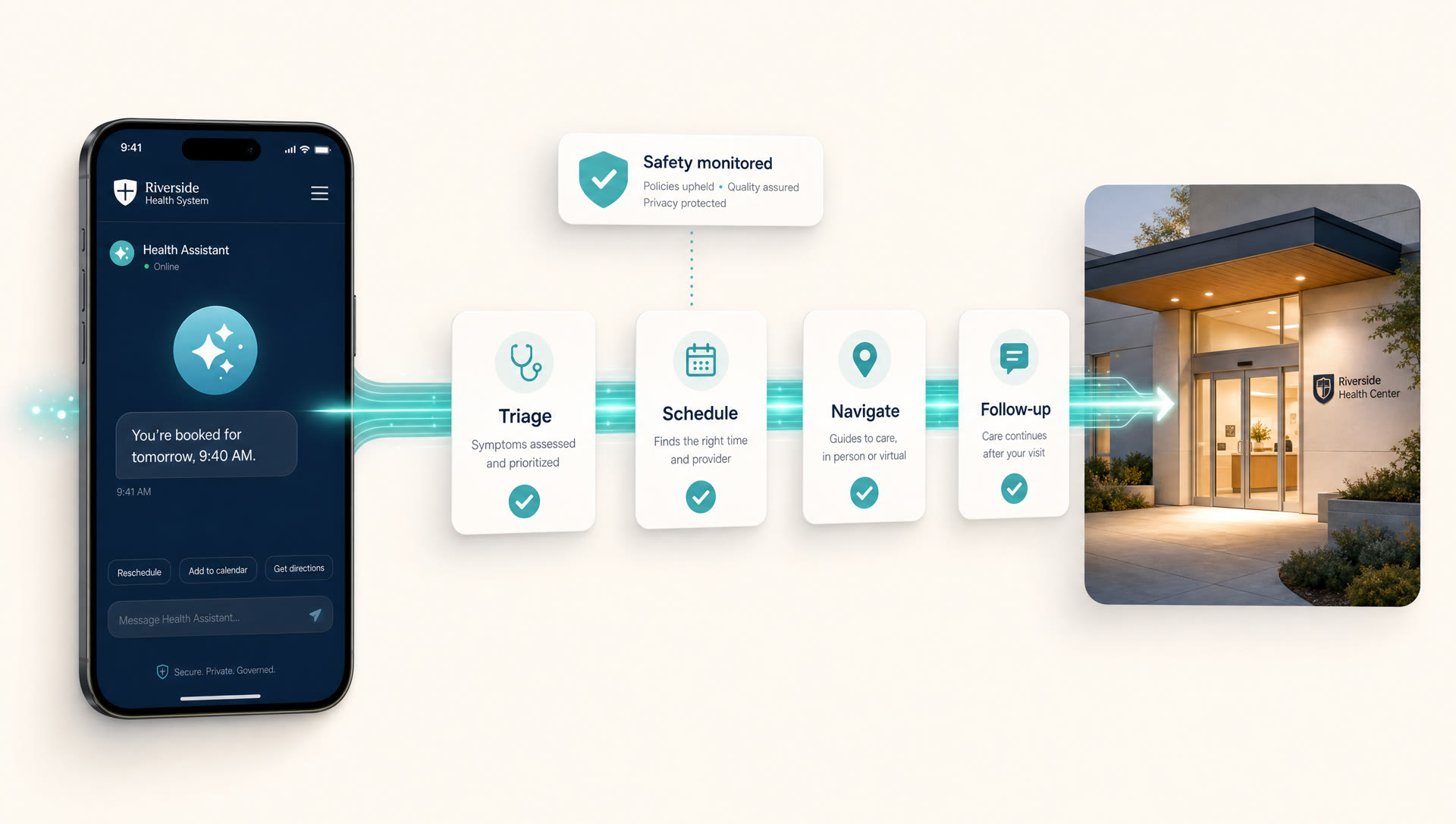
The front door of American health care is being rebuilt around AI, and the window to influence who owns it is measured in a few product cycles rather than a few strategic-planning cycles. The forces are structural and will not reverse: primary care access will remain constrained, patients will keep using AI at mainstream scale, and well-capitalized technology companies will keep building toward the entry point. The clinical evidence is unambiguous on two counts that operators must hold together. AI is improving fast enough that patients will keep using it, and it remains unsafe enough for unsupervised use that someone accountable must govern the first contact.
That someone should be the health system. The three moves that matter this quarter are within reach of any operator willing to sequence them correctly. Stabilize clinician capacity first, with ambient documentation and AI-assisted inbox management, because the evidence there is strong and the workforce crisis is the binding constraint. Build or license an integrated AI triage layer that routes patients within the network rather than away from it, because the outcome data favor integration and the alternative is exporting both the clinical benefit and the volume. Govern the whole of it for safety and equity before scaling, because an ungoverned front door is a liability and a governed one is a trust advantage.
A final consideration is trust. The front door is where confidence in a health system is established or lost, and for a growing share of patients it now takes the form of a conversation with a machine at a moment of clinical uncertainty. Systems that operate AI-mediated first contact as a governed clinical service — instrumented for safety and designed for equity — are positioned to retain the patient relationship and the demand that follows from it. Systems that cede first contact will retain their delivery assets while losing the beginning of the care episode, which is where both the relationship and the downstream volume originate.
References 91 peer-reviewed sources · 27 market & policy anchors — click to expand
Part I · Peer-reviewed literature
1. Are AI Tools Ready to Answer Patients’ Questions About Their Medical Care?. Rubin R. JAMA. 2026;:2846269.
2. ChatGPT Health Performance in a Structured Test of Triage Recommendations. Ramaswamy A, Tyagi A, Hugo H, et al. Nature Medicine. 2026;32(5):1671-1675.
3. Characterizing the Adoption and Experiences of Users of Artificial Intelligence-Generated Health Information in the United States: CrossSectional Questionnaire Study. Ayo-Ajibola O, Davis RJ, Lin ME, Riddell J, Kravitz RL. Journal of Medical Internet Research. 2024;26:e55138.
4. Online Health Information-Seeking in the Era of Large Language Models: Cross-Sectional Web-Based Survey Study. Yun HS, Bickmore T. Journal of Medical Internet Research. 2025;27:e68560.
5. Public Attitudes and Practices Toward Using AI Chatbots for Healthcare Assistance: A Multinational Cross-Sectional Study. Abdelwahed AE, Abd El-Nasser M, Heih OQ, et al. BMC Health Services Research. 2025;26(1):335.
6. Exploring Factors Influencing User Perspective of ChatGPT as a Technology That Assists in Healthcare Decision Making: A Cross Sectional Survey Study. Choudhury A, Elkefi S, Tounsi A. PloS One. 2024;19(3):e0296151.
7. Evaluation of ChatGPT-generated Medical Responses: A Systematic Review and Meta-Analysis. Wei Q, Yao Z, Cui Y, et al. Journal of Biomedical Informatics. 2024;151:104620.
8. Assessment of the Utility of Artificial Intelligence-Based Chatbots in Patient Education: A Systematic Review and Meta-Analysis. Emile SH, Horesh N, Garoufalia Z, et al. The American Surgeon. 2025;:31348251367031.
9. Accuracy and Reliability of Chatbot Responses to Physician Questions. Goodman RS, Patrinely JR, Stone CA, et al. JAMA Network Open. 2023;6(10):e2336483.
10. Comparing Physician and Artificial Intelligence Chatbot Responses to Patient Questions Posted to a Public Social Media Forum. Ayers JW, Poliak A, Dredze M, et al. JAMA Internal Medicine. 2023;183(6):589-596.
11. Changes in Short-term, Long-term, and Preventive Care Delivery in US Office-Based and Telemedicine Visits During the COVID-19 Pandemic. Cortez C, Mansour O, Qato DM, Stafford RS, Alexander GC. JAMA Health Forum. 2021;2(7):e211529.
12. "Doctor ChatGPT, Can You Help Me?" the Patient's Perspective: Cross-Sectional Study. Armbruster J, Bussmann F, Rothhaas C, et al. Journal of Medical Internet Research. 2024;26:e58831.
13. Physician and Artificial Intelligence Chatbot Responses to Cancer Questions From Social Media. Chen D, Parsa R, Hope A, et al. JAMA Oncology. 2024;10(7):956-960.
14. AI in Primary Care: Comparing ChatGPT and Family Physicians on Patient Queries. İnan M, Suvak Ö, Aypak C. A. International Journal of Medical Informatics. 2025;203:106047.
15. Doctor Versus Artificial Intelligence: Patient and Physician Evaluation of Large Language Model Responses to Rheumatology Patient Questions in a Cross-Sectional Study. Ye C, Zweck E, Ma Z, Smith J, Katz S. Arthritis & Rheumatology (Hoboken, N.J.). 2024;76(3):479-484.
16. Trends in the Types of Usual Sources of Care: A Shift from People to Places or Nothing at All. Liaw W, Jetty A, Petterson S, Bazemore A, Green L. Health Services Research. 2018;53(4):2346-2367.
17. Large Language Models Versus Healthcare Professionals in Providing Medical Information to Patient Questions: A Systematic Review. Jacobs MMG, Oosterhoff JHF, Agricola R, van der Weegen W. International Journal of Medical Informatics. 2026;209:106250.
18. Evaluating Accuracy and Reproducibility of ChatGPT Responses to Patient-Based Questions in Ophthalmology: An Observational Study. Alqudah AA, Aleshawi AJ, Baker M, et al. Medicine. 2024;103(32):e39120.
19. Generative Artificial Intelligence as a Source of Breast Cancer Information for Patients: Proceed With Caution. Park KU, Lipsitz S, Dominici LS, et al. Cancer. 2025;131(1):e35521.
20. Primary Care Access and the Role of Telemedicine for Traditional Medicare Beneficiaries. Ganguli I, Daley NE, Hicks A, et al. JAMA Health Forum. 2026;7(5):e260979.
21. Evaluation of ChatGPT as a Diagnostic Tool for Medical Learners and Clinicians. Hadi A, Tran E, Nagarajan B, Kirpalani A. PloS One. 2024;19(7):e0307383.
22. Assessing the Utility of ChatGPT Throughout the Entire Clinical Workflow: Development and Usability Study. Rao A, Pang M, Kim J, et al. Journal of Medical Internet Research. 2023;25:e48659.
23. Reliability of Medical Information Provided by ChatGPT: Assessment Against Clinical Guidelines and Patient Information Quality Instrument. Walker HL, Ghani S, Kuemmerli C, et al. Journal of Medical Internet Research. 2023;25:e47479.
24. Systematic Analysis of ChatGPT, Google Search and Llama 2 for Clinical Decision Support Tasks. Sandmann S, Riepenhausen S, Plagwitz L, Varghese J. Nature Communications. 2024;15(1):2050.
25. Large Language Models Provide Unsafe Answers to Patient-Posed Medical Questions. Draelos RL, Afreen S, Blasko B, et al. NPJ Digital Medicine. 2026;9(1):241.
26. Vulnerability of Large Language Models to Prompt Injection When Providing Medical Advice. Lee RW, Jun TJ, Lee JM, et al. JAMA Network Open. 2025;8(12):e2549963.
27. Readability, Quality, Understandability, and Actionability of ChatGPT Generated GI Patient Education Versus AGA Patient Center. Chandra S, Kumar V, Sapkota A, Kwei-Nsoro R, Almoghrabi A. Digestive Diseases and Sciences. 2026;:10.1007/s10620-026-10087-5.
28. Evaluating the Effectiveness of Artificial Intelligence-Powered Large Language Models Application in Disseminating Appropriate and Readable Health Information in Urology. Davis R, Eppler M, Ayo-Ajibola O, et al. The Journal of Urology. 2023;210(4):688-694.
29. Can AI Improve the Readability of Patient Education Information in Gynecology?. Daram NR, Maxwell RA, D'Amato J, Massengill JC. American Journal of Obstetrics and Gynecology. 2025;:S0002-9378(25)00425-9.
30. New Frontiers in Health Literacy: Using ChatGPT to Simplify Health Information for People in the Community. Ayre J, Mac O, McCaffery K, et al. Journal of General Internal Medicine. 2024;39(4):573-577.
31. Large Language Models for Chatbot Health Advice Studies: A Systematic Review. Huo B, Boyle A, Marfo N, et al. JAMA Network Open. 2025;8(2):e2457879.
32. When Patients Share Everything With an AI Chatbot. Ajunwa I, Parikh RB, Cohen IG. JAMA. 2026;:2850216.
33. ESMO Guidance on the Use of Large Language Models in Clinical Practice (ELCAP). Wong EYT, Verlingue L, Aldea M, et al. Annals of Oncology : Official Journal of the European Society for Medical Oncology. 2025;:S0923-7534(25)04698-8.
34. Solidarity or Segregation? ChatGPT Health and US Health Care Disparities. Barnhart AJ, Comerci G, Prainsack B, Braun M. Journal of Medical Internet Research. 2026;28:e94972.
35. Factors for Patient Trust and Acceptance of Medical Artificial Intelligence. Bracic A, Spector-Bagdady K, Towle S, et al. JAMA Network Open. 2026;9(3):e260815.
36. Current Concerns and Future Directions of Large Language Model chatGPT in Medicine: A Machine-Learning-Driven Global-Scale Bibliometric Analysis. Guo SB, Liu DY, Fang XJ, et al. International Journal of Surgery (London, England). 2025;:01279778-990000000-03501.
37. Testing and Evaluation of Health Care Applications of Large Language Models: A Systematic Review. Bedi S, Liu Y, Orr-Ewing L, et al. JAMA. 2025;333(4):319-328.
38. Reporting Guideline for Chatbot Health Advice Studies. CHART Collaborative, Huo B, Collins GS, et al. JAMA Network Open. 2025;8(8):e2530220.
39. A Scoping Review of Large Language Model Applications in Healthcare. Zhang Z, Nezhad MJM, Hosseini SMB, et al. Studies in Health Technology and Informatics. 2025;329:1966-1967.
40. Declining Use of Primary Care Among Commercially Insured Adults in the United States, 2008-2016. Ganguli I, Shi Z, Orav EJ, et al. Annals of Internal Medicine. 2020;172(4):240-247.
41. Trends in Pediatric Primary Care Visits Among Commercially Insured US Children, 2008-2016. Ray KN, Shi Z, Ganguli I, et al. JAMA Pediatrics. 2020;174(4):350-357.
42. Trends in Outpatient Care for Medicare Beneficiaries and Implications for Primary Care, 2000 to 2019. Barnett ML, Bitton A, Souza J, Landon BE. Annals of Internal Medicine. 2021;174(12):1658-1665.
43. Measuring the Impact of AI in the Diagnosis of Hospitalized Patients: A Randomized Clinical Vignette Survey Study. Jabbour S, Fouhey D, Shepard S, et al. JAMA. 2023;330(23):2275-2284.
44. Uptake of Generative AI Integrated With Electronic Health Records in US Hospitals. Everson J, Nong P, Richwine C. JAMA Network Open. 2025;8(12):e2549463.
45. Decreasing Use of Primary Care: A Repeated Cross-Sectional Study of MEPS 2007-2017. Johansen ME, Niforatos JD. Annals of Family Medicine. 2021 Jan-Feb;19(1):41-43.
46. Adoption of Artificial Intelligence in the Health Care Sector. Nguyen TD, Whaley CM, Simon K, et al. JAMA Health Forum. 2025;6(11):e255029.
47. Primary Care Office Visits for Acute Care Dropped Sharply in 2002-15, While ED Visits Increased Modestly. Chou SC, Venkatesh AK, Trueger NS, Pitts SR. Health Affairs (Project Hope). 2019;38(2):268-275.
48. National Trends in Primary Care Visit Use and Practice Capabilities, 2008-2015. Rao A, Shi Z, Ray KN, Mehrotra A, Ganguli I. Annals of Family Medicine. 2019;17(6):538-544.
49. Trends in Visits to Acute Care Venues for Treatment of Low-Acuity Conditions in the United States From 2008 to 2015. Poon SJ, Schuur JD, Mehrotra A. JAMA Internal Medicine. 2018;178(10):1342-1349.
50. Urgent Care Center and Retail Health Clinic Use: United States, 2024. Cohen RA, Briones EM. NCHS Data Brief. 2026;(562).
51. Trends in Urgent Care Utilization Among Medicare Beneficiaries From 2012 to 2019. Mantilla JJ, Burke RC, Orav EJ, et al. JAMA Network Open. 2026;9(1):e2555345.
52. Visits to Retail Clinics Grew Fourfold From 2007 to 2009, Although Their Share of Overall Outpatient Visits Remains Low. Mehrotra A, Lave JR. Health Affairs (Project Hope). 2012;31(9):2123-9.
53. The Geographic Accessibility of Retail Clinics for Underserved Populations. Pollack CE, Armstrong K. Archives of Internal Medicine. 2009;169(10):945-9; discussion 950-3.
54. Retail Clinic Visits and Receipt of Primary Care. Reid RO, Ashwood JS, Friedberg MW, et al. Journal of General Internal Medicine. 2013;28(4):504-12.
55. Comparing Costs and Quality of Care at Retail Clinics With That of Other Medical Settings for 3 Common Illnesses. Mehrotra A, Liu H, Adams JL, et al. Annals of Internal Medicine. 2009;151(5):321-8.
56. Comparing Retail Clinics With Other Sites of Care: A Systematic Review of Cost, Quality, and Patient Satisfaction. Hoff T, Prout K. Medical Care. 2019;57(9):734-741.
57. Use and Content of Primary Care Office-Based vs Telemedicine Care Visits During the COVID-19 Pandemic in the US. Alexander GC, Tajanlangit M, Heyward J, et al. JAMA Network Open. 2020;3(10):e2021476.
58. Temporal Trends and Sociodemographic Differences in Telemedicine Utilization, 2019-2024. Zhang B, Li L, Lu Y, et al. Journal of General Internal Medicine. 2026;41(9):2407-2415.
59. Prevalence and Disparities in Telehealth Use Among US Adults Following the COVID-19 Pandemic: National Cross-Sectional Survey. Spaulding EM, Fang M, Commodore-Mensah Y, et al. Journal of Medical Internet Research. 2024;26:e52124.
60. Telemedicine in the Post-Pandemic Period: Understanding Patterns of Use and the Influence of Socioeconomic Demographics, Health Status, and Social Determinants. Chandrasekaran R. Telemedicine Journal and E-Health : The Official Journal of the American Telemedicine Association. 2024;30(2):480-489.
61. Patient Characteristics and Telemedicine Use in the US, 2022. Chang E, Penfold RB, Berkman ND. JAMA Network Open. 2024;7(3):e243354.
62. Telemedicine and Primary Care Access: A Cross-Sectional Observational Study of Patients Using Only Telemedicine. Tierney AA, Huang J, Gopalan A, et al. Journal of General Internal Medicine. 2025;40(14):3363-3370.
63. Patient-Reported Primary Care Video and Telephone Telemedicine Preference Shifts During the COVID-19 Pandemic. Millman A, Huang J, Graetz I, et al. Medical Care. 2023;61(11):772-778.
64. Exploring the Patient Experience and Perspective in Virtual-First Primary Care: A Cross-Sectional Study From an Integrated Health System. Saiyed SM, Sayed RE, Khattab S, Yassin A. Telemedicine Journal and E-Health : The Official Journal of the American Telemedicine Association. 2024;30(6):e1769-e1780.
65. An Episode-Based Cost Analysis of Virtual-First Versus in-Person-First Care to Treat Common Acute Conditions Among Members of a Large National Payor. Zaleski AL, Guan X, Thomas Craig KJ, et al. BMC Health Services Research. 2025;25(1):994.
66. Comparison of Direct-to-Consumer Telemedicine Visits With Primary Care Visits. Jain T, Mehrotra A. JAMA Network Open. 2020;3(12):e2028392.
67. Disconnected: A Survey of Users and Nonusers of Telehealth and Their Use of Primary Care. Liaw WR, Jetty A, Coffman M, et al. Journal of the American Medical Informatics Association : JAMIA. 2019;26(5):420-428.
68. Virtual Visits With Own Family Physician vs Outside Family Physician and Emergency Department Use. Lapointe-Shaw L, Salahub C, Austin PC, et al. JAMA Network Open. 2023;6(12):e2349452.
69. Choice, Transparency, Coordination, and Quality Among Direct-to-Consumer Telemedicine Websites and Apps Treating Skin Disease. Resneck JS, Abrouk M, Steuer M, et al. JAMA Dermatology. 2016;152(7):768-75.
70. Antibiotic Receipt for Pediatric Telemedicine Visits With Primary Care vs Direct-to-Consumer Vendors. Wittman SR, Hoberman A, Mehrotra A, et al. JAMA Network Open. 2024;7(3):e242359.
71. Treatment and Follow-up Care Associated With Patient-Scheduled Primary Care Telemedicine and In-Person Visits in a Large Integrated Health System. Reed M, Huang J, Graetz I, et al. JAMA Network Open. 2021;4(11):e2132793.
72. Source of Usual Health Care for Adults Age 18 and Older: United States, 2024. Mykyta L, Weeks JD. NCHS Data Brief. 2026;(558).
73. The Association Between Continuity of Care and the Overuse of Medical Procedures. Romano MJ, Segal JB, Pollack CE. JAMA Internal Medicine. 2015;175(7):1148-54.
74. Ambulatory Care Fragmentation, Emergency Department Visits, and Race: A Nationwide Cohort Study in the U.S. Kern LM, Ringel JB, Rajan M, et al. Journal of General Internal Medicine. 2023;38(4):873-880.
75. Ambulatory Care Fragmentation and Subsequent Hospitalization: Evidence From the REGARDS Study. Kern LM, Ringel JB, Rajan M, et al. Medical Care. 2021;59(4):334-340.
76. Care Fragmentation, Quality, and Costs Among Chronically Ill Patients. Frandsen BR, Joynt KE, Rebitzer JB, Jha AK. The American Journal of Managed Care. 2015;21(5):355-62.
77. Association of Primary Care Physician Supply With Population Mortality in the United States, 2005-2015. Basu S, Berkowitz SA, Phillips RL, et al. JAMA Internal Medicine. 2019;179(4):506-514.
78. The National Physician Shortage: Disconcerting HRSA and AAMC Reports. Adashi EY, O'Mahony DP, Gruppuso PA. Journal of General Internal Medicine. 2025;:10.1007/s11606-025-09575-7.
79. Self-Reported Panel Size Among Family Physicians Declined by Over 25% Over a Decade (2013-2022). Bazemore A, Morgan ZJ, Grumbach K. Journal of the American Board of Family Medicine : JABFM. 2024 May-Jun;37(3):504-505.
80. Challenges to the Future of a Robust Physician Workforce in the United States. Walensky RP, McCann NC. The New England Journal of Medicine. 2025;392(3):286-295.
81. Trends in US Ambulatory Care Patterns During the COVID-19 Pandemic, 2019-2021. Mafi JN, Craff M, Vangala S, et al. JAMA. 2022;327(3):237-247.
82. From Revolution to Evolution: Early Experience With Virtual-First, Outcomes-Based Primary Care. Ellner A, Basu N, Phillips RS. Journal of General Internal Medicine. 2023;38(8):1975-1979.
83. Understanding Liability Risk from Using Health Care Artificial Intelligence Tools. Mello MM, Guha N. The New England Journal of Medicine. 2024;390(3):271-278.
84. Ambient AI Tool Adoption in US Hospitals and Associated Factors. Yang F, Graetz I. The American Journal of Managed Care. 2026;32(1):e25-e30.
85. Use Characteristics and Triage Acuity of a Digital Symptom Checker in a Large Integrated Health System: Population-Based Descriptive Study. Morse KE, Ostberg NP, Jones VG, Chan AS. Journal of Medical Internet Research. 2020;22(11):e20549.
86. Health Information Seeking From an Intelligent Web-Based Symptom Checker: Cross-Sectional Questionnaire Study. Arellano Carmona K, Chittamuru D, Kravitz RL, Ramondt S, Ramírez AS. Journal of Medical Internet Research. 2022;24(8):e36322.
87. Association of Use of Online Symptom Checkers With Patients’ Plans for Seeking Care. Winn AN, Somai M, Fergestrom N, Crotty BH. JAMA Network Open. 2019;2(12):e1918561.
88. How Accurate Are Digital Symptom Assessment Apps for Suggesting Conditions and Urgency Advice? A Clinical Vignettes Comparison to GPs. Gilbert S, Mehl A, Baluch A, et al. BMJ Open. 2020;10(12):e040269.
89. The Diagnostic and Triage Accuracy of Digital and Online Symptom Checker Tools: A Systematic Review. Wallace W, Chan C, Chidambaram S, et al. NPJ Digital Medicine. 2022;5(1):118.
90. Triage Accuracy of Symptom Checker Apps: 5-Year Follow-Up Evaluation. Schmieding ML, Kopka M, Schmidt K, et al. Journal of Medical Internet Research. 2022;24(5):e31810.
91. Appropriateness and Utility of a Clinical Decision Support System at the Digital Front Door. Pimenta A, Kini N, Cotte F, et al. NPJ Digital Medicine. 2026;:10.1038/s41746-026-02711-5.
Part II · Market and policy anchors
Access and Workforce
92. HRSA / NCHWA — 76M in primary care shortage areas; 87,150 FTE PCP shortfall projected by 2037.
93. AAMC — projected physician shortage (~86,000 by 2036).
94. Healthcare Dive — 100M+ Americans lack a regular source of care.
95. AMA — physician shortage crisis (83M with insufficient PCP access).
Patient AI Adoption
96. KFF — 1 in 3 adults turning to AI chatbots for health information (Tracking Poll, fielded Feb–Mar 2026).
97. KFF Tracking Poll on Health Information and Trust — social media and AI for health information.
98. KFF — June 2024 baseline (17% monthly AI-for-health use).
99. Modern Healthcare — nearly half of AI health users do not follow up with a clinician.
Consumer Decision Journey
100. Zocdoc — What Patients Want 2025 (positive connection ranked first; 93% booked in person).
101. Zocdoc via TechTarget — 93% in-person booking; timely access valued in 2025.
102. rater8 — How Patients Choose Their Doctors 2025 (61% weight reviews over referrals).
103. rater8 — Next Evolution of Patient Choice (35% social media, 25% voice assistants).
104. Healthgrades–Zocdoc — reviews-plus-booking partnership and phone-friction stats.
Retail Retreat and Platform Ascent
105. AHA Market Scan — Walgreens, CVS, Walmart scale back care amid financial strain.
106. Fierce Healthcare — Walmart shutters all 51 health centers and virtual care (2024).
107. CNBC — why the Walmart/Walgreens/CVS retail clinic experiment is struggling (Mehrotra).
108. AHA Market Scan — Amazon's One Medical ramps expansion into primary care (Prime bundle).
109. Becker's — health systems expand Amazon One Medical partnerships.
110. Becker's ASC — Amazon healthcare strategy including AI tool and Rush partnership.
111. One Medical / Amazon — current membership terms. A I FRONT-DOOR VENDORS
112. Hippocratic AI — $126M Series C at $3.5B valuation (Nov 2025). [CONFIRMED]
113. Fierce Healthcare — Hippocratic AI Series C detail, patient-facing agents.
114. UHS — Hippocratic AI post-discharge program (9.0/10 patient rating).
115. University Hospitals — collaboration with Hippocratic AI.
Economics and Evaluation
116. PHTI — assessments hub (independent digital health evaluation).
117. PHTI — AI Taskforce.
118. PHTI — Digital Health Assessment Framework (ICER methodology). [CONFIRMED]