
The Centers for Medicare & Medicaid Services released the calendar year (CY) 2027 Medicare Physician Fee Schedule (PFS) proposed rule on July 14, 2026.1 Although many headlines will focus on another decline in the conversion factor, orthopedic surgeons face a more consequential combination of proposed changes. A week earlier, on July 7, CMS published the companion CY 2027 Hospital Outpatient Prospective Payment System and Ambulatory Surgical Center (OPPS/ASC) proposed rule.2 Read together, the two rules describe a coherent policy program: pay facilities more, pay surgeons less, and use the migration of surgery out of the hospital as the evidentiary engine for both.
CMS estimates that the PFS rule's relative value unit (RVU) changes would reduce aggregate PFS allowed charges for orthopedic surgery by 7%. The agency estimates a 5% reduction for orthopedic services furnished in non-facility settings and an 8% reduction in facility settings.1 These are specialty-wide averages, not predictions for an individual surgeon, but they place orthopedic surgery among the specialties facing the largest proposed reductions.
The most important caveat is that these are proposed rules. Policies and values may change in the final rules, and Congress could alter the statutory payment update. Comments on the PFS rule (CMS-1848-P) are due September 14, 2026.3 Comments on the OPPS/ASC rule (CMS-1850-P) are due August 31, 2026.4
Read this free. Work it with the subscriber tools.
This analysis is free here and on the Techy Surgeon Substack. Subscribers on techysurgeon.com get the working tools built from it: the 2027 Practice Impact Calculator (your case volumes, your estimated delta), the CMS comment-letter template for both dockets, and the RTM vendor-contract audit checklist. Part 2 of this series, on the digital health fallout, is subscriber-only.
1.The conversion factor would fall, despite positive statutory updates
Medicare has used two PFS conversion factors since 2026: one for qualifying participants in Advanced Alternative Payment Models (APMs) and one for clinicians who are not qualifying participants.
CMS proposes a CY 2027 conversion factor of $33.1693 for qualifying APM participants, down 1.19% from $33.5675 in 2026. For nonqualifying clinicians, CMS proposes $32.8409, down 1.68% from $33.4009.1
The decline occurs even though qualifying APM participants receive a statutory 0.75% update and other clinicians receive a 0.25% update. The reason is that a one-year 2.5% increase enacted for 2026 expires at the end of that year. A proposed positive 0.53% budget-neutrality adjustment only partly offsets that expiration.1
For orthopedic practices, the conversion-factor decline compounds the specialty-specific RVU changes. Applying the rounded 7% specialty estimate together with the proposed conversion-factor changes suggests an average reduction on the order of 8% to 9% in PFS allowed charges, all else equal. That is only a directional estimate: each practice's result will depend on its code mix, geography, site of service, APM status, modifiers, and participation in other payment models.
The longer arc
The 2027 proposal continues a two-decade pattern rather than departing from it. The AMA calculates that Medicare physician payment declined 33% from 2001 to 2025 after adjusting for practice-cost inflation, while the cost of running a practice rose 59%.6 Budget neutrality, not clinical judgment, is the machine that produces this: any RVU increase elsewhere in the fee schedule must be financed by cuts somewhere else, and procedural specialties have been the somewhere else for most of the period. MedPAC has repeatedly recommended tying updates to the Medicare Economic Index; Congress has so far preferred one-year patches like the 2.5% increase that expires this December.7
2.Orthopedic surgery's specialty impact is unusually negative
CMS projects the following aggregate RVU effects for orthopedic surgery (Table D-B5 of the proposed rule):1
| Setting | CY 2026 allowed charges used by CMS | Work RVU impact | PE RVU impact | Malpractice RVU impact | Combined |
|---|---|---|---|---|---|
| All settings | $3.296 billion | −3% | −4% | −1% | −7% |
| Non-facility | $1.549 billion | −2% | −4% | 0% | −5% |
| Facility | $1.747 billion | −4% | −4% | −1% | −8% |
CMS says the largest specialty-level decreases generally arise from three sources: revaluation of specific services, the proposed treatment of same-day office/outpatient E/M visits reported with modifier 25, and changes to the practice-expense methodology. Previously finalized code reductions that are still being phased in, including the 2.5% "efficiency adjustment" applied to non-time-based work RVUs beginning in 2026, also contribute.1
The table is based on national Medicare utilization and represents PFS allowed charges, including beneficiary cost sharing. It does not measure total practice revenue, and it does not account for hospital or ambulatory surgical center facility payments made under other Medicare payment systems. Those systems are moving in the opposite direction, as covered in section 10.
3.CMS proposes substantial work-RVU reductions for major joint replacements
CMS proposes to reduce work RVUs for several high-volume orthopedic procedures after identifying what it calls a site-of-service anomaly. Medicare data from 2021 to 2023 showed that the procedures were furnished less than half the time in the inpatient setting even though their 90-day global valuations included inpatient hospital visits.1
| Procedure | CPT | Current work RVU | RUC recommendation | Proposed work RVU | Change |
|---|---|---|---|---|---|
| Shoulder hemiarthroplasty | 23470 | 17.44 | 15.60 | 13.81 | −20.8% |
| Total shoulder arthroplasty | 23472 | 21.58 | 19.35 | 17.49 | −19.0% |
| Total hip arthroplasty | 27130 | 19.11 | 16.70 | 15.37 | −19.6% |
| Total knee arthroplasty | 27447 | 19.11 | 16.70 | 15.94 | −16.6% |
Note the middle column. CMS' proposed values sit below even the reduced recommendations of the AMA/Specialty Society Relative Value Scale Update Committee (RUC), which had already cut roughly 10% to 13% from current values. The agency's rationale is that surveyed total time and postoperative visit assumptions declined as these procedures moved toward outpatient care, while the recommended RVUs did not decline proportionately. CMS instead crosswalked each code to procedures with similar intraservice times, preserving what it considers the current intensity per minute.1
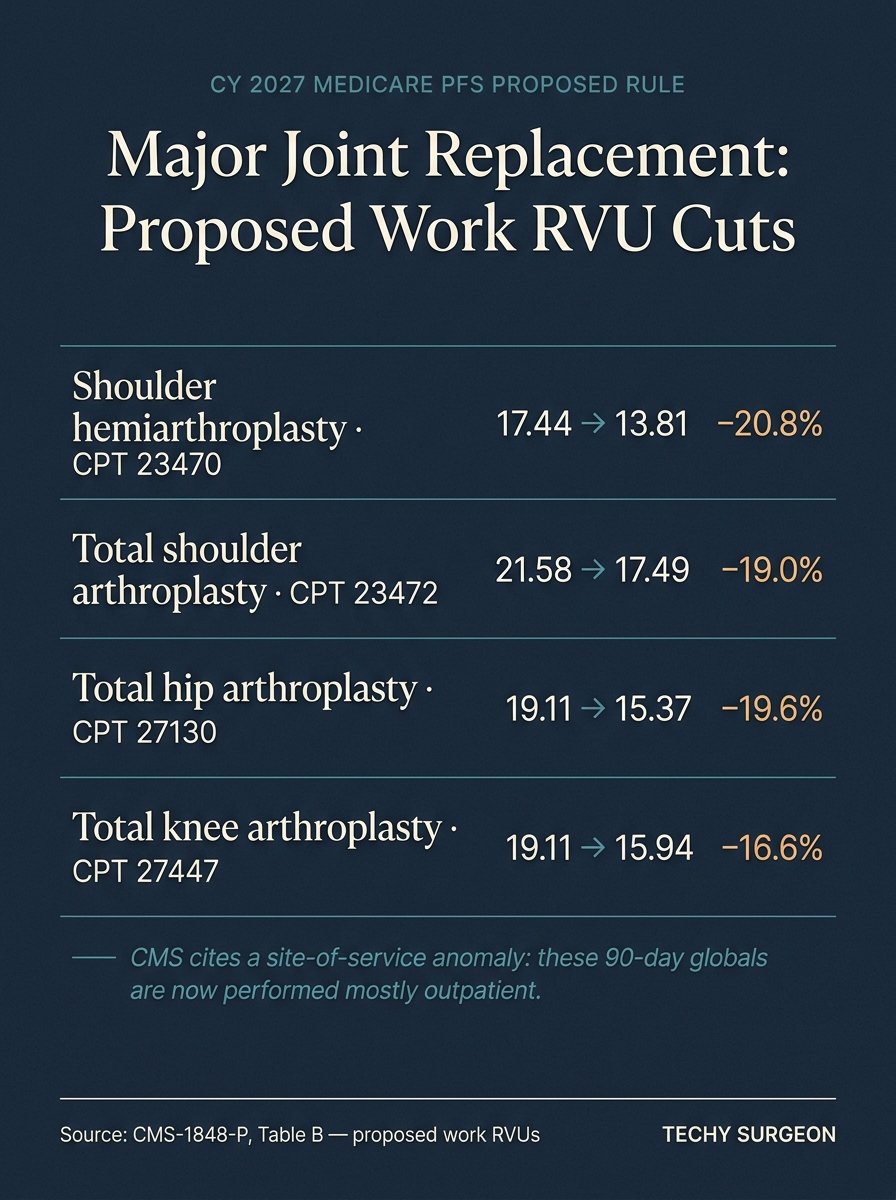
These percentages apply only to the work-RVU component, not the entire Medicare payment. Even so, the proposed changes are large enough that joint-replacement practices should model them code by code.
Other orthopedic and spine proposals include work RVUs of 23.12 for CPT 22210, 21.72 for CPT 22212, 19.53 for CPT 22214, and 3.00 for CPT 22216 (spinal osteotomy family); proposed work RVUs of 7.66 and 11.00 for sacroiliac joint arthrodesis codes 27278 and 27279; and proposed values for new services describing implantation of a medial-knee extra-articular shock absorber and a knee osteochondral acellular scaffold. CMS would maintain a 2.44 work RVU for computer-assisted musculoskeletal surgical navigation, CPT 20985, whose descriptor has been revised.1
4.Same-day E/M visits with modifier 25 could be paid at 50%
CMS proposes a multiple-procedure-style reduction when a separately identifiable office or outpatient E/M visit is furnished by the same physician (or another physician in the same group) to the same patient on the same day as a procedure with a 0-, 10-, or 90-day global period.1
Under the proposal, the highest-paid service would be paid at 100%. Every other affected procedure or E/M service would be paid at 50%. The policy would apply even when the E/M visit is properly supported as significant and separately identifiable and reported with modifier 25. CMS first floated this in the CY 2019 proposed rule and did not finalize it; it is asking this time whether 25% would be a more appropriate reduction than 50%.1
This matters in orthopedics when an evaluation leads to a same-day injection, fracture treatment, minor procedure, or other global service. It also creates an operational tension: separating medically appropriate services merely to avoid a reduction could inconvenience patients, and CMS explicitly warns against scheduling care on different days solely to maximize payment.
Practices should quantify how often modifier 25 appears with 0-, 10-, and 90-day global procedures and identify the clinical scenarios responsible. Documentation remains essential, but documentation alone would not prevent the proposed 50% reduction.
5.Practice-expense reform is a major part of the orthopedic reduction
Practice expense accounts for office staff, rent, supplies, equipment, and other costs of furnishing a service. CMS proposes to phase out the indirect practice cost index, the final step in the PE methodology that keeps specialty-level practice-expense RVUs anchored to practice-expense-per-hour survey data from 2007 or earlier. The agency would replace it with a PE stabilizer, a new final step that caps year-over-year movement in any code's PE RVU at 5% in either direction, intended to reduce short-term volatility without permanently anchoring payments to old specialty data. The stabilization cap applies before the separate statutory phase-in that limits total RVU reductions to 19% per year for existing codes.11,1
CMS attributes much of the negative projected impact for orthopedic surgery to the PE changes. For independent orthopedic groups, a 4% aggregate practice-expense RVU reduction is especially important because overhead does not fall when an RVU is reduced. Practices should therefore analyze professional reimbursement and operating cost separately rather than treating an RVU decline as a simple margin-neutral price adjustment.
A comment solicitation buried in the PE section deserves more attention than it will get. CMS asks how much indirect practice expense hospital-employed physicians actually incur when they furnish care in a facility, and whether the current 50% indirect PE allocation for facility-based services should be lower, "such as 0 percent."1 For the majority of orthopedic surgeons who are now hospital- or system-employed, that question is a signal about where facility-setting professional payment could go in future rulemaking.
6.Global surgical packages remain under scrutiny
CMS proposes to pause the mandatory collection of postoperative visit data through no-pay CPT 99024. The agency says its existing data, including the RAND analyses conducted under MACRA, show that included postoperative visits often do not occur, even though payment for those visits remains embedded in global surgical packages.1
The pause is not a retreat from revaluation. CMS is publishing a file that estimates the work RVUs remaining if postoperative visits were removed from 10- and 90-day global services and is asking whether all clinicians should eventually report 99024. For orthopedic surgery, whose payment structure relies heavily on 90-day globals, the direction is clear: CMS continues to question whether global packages reflect current patterns of care. This is the same logic that produced the joint-replacement cuts in section 3, applied to the entire surgical fee schedule.
Practices should not assume that current global valuations are stable. Accurate tracking of postoperative visits, transfers of care, and use of applicable modifiers will be increasingly important if CMS pursues broader revaluation in future rulemaking.
7.Remote therapeutic monitoring would face tighter conditions and lower resource assumptions
Remote therapeutic monitoring (RTM) is particularly relevant to musculoskeletal care. CMS proposes that beginning in 2027:1
- RTM may be furnished only to established patients, matching the rule that already applies to remote physiologic monitoring (RPM).
- The billing practitioner must initiate RTM or RPM during a separately reportable face-to-face visit, which may occur in person or by telehealth.
- Clinical-staff work may count only when the staff member is a direct employee of the practitioner or practice; contracted third-party clinical staff would not qualify.
- CMS would revalue device-supply and setup services based on lower-cost crosswalks and remove practice-expense inputs from treatment-management codes while retaining their current work RVUs and work times.
CMS is also seeking comment on replacing the existing remote-monitoring code families, seventeen codes in all, with four bundled HCPCS G-codes. Orthopedic practices using musculoskeletal RTM codes, including CPT 98977 and 98985, should review vendor contracts, staffing arrangements, initiating-visit workflows, consent processes, and device costs now.
If your RTM program is operated by a vendor whose clinical staff are not your employees, the billing model that supports it may not survive the final rule. These proposals detonate under a large share of the digital health vendors selling into orthopedic practices today, and the fallout deserves its own analysis: which business models die, which survive, and what the SaMS payment lane and the technology-RFI language mean for the companies still standing. That piece is Part 2 of this series, available to subscribers: read the teaser and unlock it here.
8.The mandatory Ambulatory Specialty Model begins in 2027 for selected spine clinicians
The Ambulatory Specialty Model (ASM), finalized in the 2026 rule, begins January 1, 2027. It is a mandatory five-year model for selected specialists in designated geographic areas. Orthopedic surgeons may be included in the low-back-pain cohort if they meet CMS' specialty, episode-volume, claims, and location criteria.1
ASM evaluates participants at the individual TIN/NPI level across quality, cost, improvement activities, and Promoting Interoperability. Performance in a year affects all Medicare Part B covered professional services two years later. Adjustments range from −9% to +9% in the first two payment years and rise to as much as −12% to +12% in the final payment year.1
For 2027, CMS proposes to add an administrative claims-based measure of potentially unnecessary lumbar MRI use, replace the retiring low-back functional-status measure with MIPS measure Q182, Functional Outcome Assessment, and offer a scoring incentive for voluntary patient-reported outcome data submission. The agency also proposes a rural scoring adjustment and would allow multiple ASM participants billing under the same TIN to share one collaborative care arrangement with a primary care practice, provided the requirements are met.1
Spine practices should confirm whether each surgeon is likely to be selected, establish ownership of ASM reporting, review lumbar MRI ordering patterns, build a reliable functional-outcome workflow, and identify primary care partners. Because the model scores individual clinicians, a group-level compliance program must still preserve surgeon-level data.
9.MIPS is moving toward core measures and mandatory MVP reporting
For the 2027 MIPS performance period, CMS proposes to require clinicians to report at least one designated MIPS core quality measure when an applicable core measure is available. In the Improving Care for Lower Extremity Joint Repair MVP, the proposed core measures are:1
- Q351, venous thromboembolic and cardiovascular risk evaluation before total knee or hip replacement;
- Q470, functional status after primary total knee replacement; and
- Q480, the risk-standardized complication rate following elective primary hip or knee arthroplasty.
CMS also proposes to remove Q350, which addresses shared decision-making and a trial of conservative therapy, from that MVP. More broadly, CMS proposes to end traditional MIPS after the 2028 performance year and require MVP reporting beginning with the 2029 performance period, except for clinicians using the APM Performance Pathway.1
The practical message is to treat patient-reported outcomes and structured functional assessment as core infrastructure, not optional registry work. The same capabilities increasingly support MIPS, ASM, payer contracts, and clinical improvement.
10.The OPPS side: facility payment moves the other way
While the PFS conversion factor falls, the OPPS rule proposes to increase hospital outpatient payment rates by 2.4% for CY 2027, based on a 3.2% hospital market-basket increase minus a 0.8 percentage point productivity adjustment. CMS estimates total OPPS payments of approximately $110.9 billion in 2027, an increase of about $9.5 billion. ASC rates would also rise 2.4%, with total ASC payments estimated at $9.9 billion, up about $520 million.2
The surgeon's professional fee and the facility fee for the same episode are now priced by two systems moving in opposite directions.
The asymmetry is structural, not accidental. Facility updates are tied by statute to a market-basket inflation measure; physician updates are not tied to any inflation measure at all. Every year that structure persists, the professional share of the total episode payment shrinks. For employed surgeons, this shifts negotiating leverage toward the systems that capture the facility fee. For independent groups with ASC ownership, it does the opposite: the ASC facility fee is one of the few Medicare revenue lines in orthopedics with a guaranteed positive update, which is worth remembering when weighing practice-model decisions against a 7% professional cut.
11.The inpatient-only list is going away, and it is feeding back into your RVUs
The OPPS rule continues the elimination of the inpatient-only (IPO) list that CMS finalized in the CY 2026 rule. The first phase removed 285 mostly musculoskeletal procedures for CY 2026. For CY 2027, CMS proposes to remove 637 additional services from eleven non-musculoskeletal clinical families. The regulation now states that the list will be eliminated in its entirety by January 1, 2029. Two-midnight-rule exemptions continue for services coming off the list.2 Alongside this, CMS proposes to add 618 codes to the ASC covered procedures list for CY 2027.2
The strategic point for orthopedic surgeons is the loop itself. CMS removes procedures from the IPO list; volume shifts outpatient; the shift shows up in claims data; the claims data trigger the site-of-service anomaly screen; the anomaly screen produces work-RVU cuts. The CY 2027 joint-replacement reductions are the first large orthopedic application of this mechanism, and the 285 musculoskeletal procedures that came off the IPO list in 2026 are now generating the utilization data that could support the next round. Spine, foot and ankle, and upper-extremity codes with 90-day globals and growing outpatient share are the obvious candidates.
None of this means outpatient migration is bad medicine. Shorter stays, better anesthesia, and modern recovery protocols are real, and many of us helped build them. It means the efficiency surgeons created is being repriced out of the professional fee, while the facility side of the ledger receives an inflation-linked update. Comment letters that document what actually happens in the 90 days after an outpatient arthroplasty, including who does the work that the hospital no longer does, are the most useful response.
12.Smaller OPPS signals worth logging
- Quality reporting. CMS proposes to remove the follow-up-after-normal-colonoscopy measure from both the Hospital Outpatient Quality Reporting and ASC Quality Reporting programs, refines eCQM validation procedures, and floats an advance-care-planning measure for the outpatient setting. The THA/TKA patient-reported outcome measure infrastructure adopted in earlier rules continues; outpatient joint programs should keep building PRO collection capacity.2
- Prior authorization. CMS proposes to expand the hospital outpatient prior-authorization program to eight additional botulinum-toxin codes beginning July 1, 2027. Not an orthopedic category today, but the program has grown steadily since 2020 and signals continued scrutiny of OPD utilization.2
- Price transparency. The rule includes a request for information on strengthening the standardization and comparability of hospital price transparency data. Better-standardized facility pricing data will eventually reach payers, employers, and patients comparing sites for elective orthopedic surgery.2
- 340B. Hospitals subject to the 340B remedy offset would see payments reduced by 3 percentage points, part of the continuing unwinding of the 2018–2022 340B payment litigation.2
What orthopedic practices should do now
First, build a 2027 Medicare forecast using actual 2025 or trailing-12-month utilization. Apply the proposed code-level RVUs and the correct qualifying or nonqualifying conversion factor rather than relying only on the specialty average.
Second, isolate the exposure from CPT 23470, 23472, 27130, and 27447. Model work-RVU, total-RVU, compensation-plan, and service-line effects separately. Surgeon compensation formulas based on work RVUs may transmit the reduction differently from practice collections, and a wRVU-based employment agreement can convert a Medicare fee cut into an all-payer compensation cut if the conversion factors in the contract are not renegotiated.
Third, audit same-day E/M services reported with modifier 25. Measure the revenue at risk under a 50% reduction and document the clinical reasons those services occur on the same date.
Fourth, review RTM operations and contracts. A vendor model that depends on contracted clinical staff may no longer support Medicare billing if the proposal is finalized.
Fifth, prepare spine clinicians for ASM and joint surgeons for MIPS core measures. Confirm EHR and registry readiness for functional outcomes, complication measures, cost feedback, and surgeon-level attribution.
Sixth, model the facility side of your episode economics. If you are employed, understand how much of your system's orthopedic margin now rides on OPPS and ASC updates you never see. If you are independent, the ASC facility fee is the one orthopedic Medicare revenue line with a statutory inflation link, which belongs in any practice-model analysis.
Finally, comment on both rules. OPPS/ASC comments (CMS-1850-P) close August 31, 2026; PFS comments (CMS-1848-P) close September 14, 2026.3,4 The strongest comments will include code-specific time data, postoperative utilization, actual practice-expense information, device invoices, patient-access implications, and workable alternatives, not only objections to the size of the reduction.
The signal underneath the rules: my read as a specialist and an operator
Step back from the code-level detail and the two rules point one direction. CMS is engineering a shift toward longitudinal, outcomes-based payment with primary care at the center. The agency says so in its own fact sheet: a comment solicitation on prospective primary care payment in the Shared Savings Program and potentially in Original Medicare broadly, a proposal to convert the G2211 complexity add-on into a modifier worth 16% on the E/M base rate, and a second modifier worth 32% reserved for clinicians in accountable care organizations providing longitudinal care.11 Primary care gets new upside. That is defensible policy, and much of it is overdue.
My concern is the specialist side of the ledger. For surgeons, this rule is nearly all downside exposure: RVU cuts, global-period scrutiny, practice-expense reallocation, and a mandatory model (ASM) whose defining feature is two-sided risk imposed rather than opportunity designed. Specialists are being asked to absorb the cost of the transition without a commensurate mechanism to participate in its rewards. If CMS believes longitudinal accountability is the future, specialist engagement should be engineered into the models as a required design element, not offered as an afterthought once primary care structures are built.
The place to watch is bundled payment. With the inpatient-only list ending by 2029 and 618 more codes proposed for the ASC list, surgical episodes are moving to settings the current episode models were not built around. CMMI's anticipated next generation of bundled payment, whatever final form the successor to BPCI Advanced takes, will need to follow surgery into the ASC. When it does, the practices that already operate as episode managers, with PRO collection running, postoperative pathways documented, and primary care relationships formalized, will be the ones positioned to hold risk rather than merely bear it.
That is the work in front of us: bringing specialists and primary care clinicians to the same table before the models force the introduction. ASM's collaborative care arrangements are a primitive version of the right idea. The mature version is a shared longitudinal journey for the patient's condition, musculoskeletal disease in my world, with the surgeon accountable for the episode and primary care accountable for the continuum, and payment that recognizes both. We are building toward exactly that thesis with MSK Access at RevelAi, and the direction of these rules is why.
Bottom line
The CY 2027 proposed rules would not simply trim the conversion factor. They would reallocate RVUs away from orthopedic surgery, reduce the work values of major joint replacements below even the RUC's reduced recommendations, change same-day E/M payment, weaken the link between practice-expense RVUs and historical specialty data, tighten RTM billing, and bring selected spine clinicians into a mandatory model with two-sided payment risk. On the facility side, the same agency proposes a 2.4% update, finishes dismantling the inpatient-only list by 2029, and expands the ASC covered list by 618 codes.
Orthopedic practices should treat the proposals as a call for immediate financial modeling and operational preparation. The final rules may change, but the policy direction is consistent across both documents: greater scrutiny of procedural valuation, global periods, site of service, remote monitoring, imaging use, and measurable outcomes. Part 2 of this series, on what these rules do to the digital health companies selling into your practice, is available now for subscribers: start here.