Most health tech operators will skim the CY 2027 Medicare proposed rules for their own billing codes and move on. That is a mistake. The Physician Fee Schedule rule (CMS-1848-P, released July 14, 2026)1 and the Hospital Outpatient/ASC rule (CMS-1850-P, published July 7)2 contain the clearest statement CMS has made about how it intends to pay for technology-enabled care: which delivery models it will fund, which staffing arrangements it will disqualify, which software categories get a payment lane, and whose efficiency gains it plans to capture. If your company sells into Medicare-billing providers, at least one section of these rules touches your revenue model. Comments are due September 14 (PFS)3 and August 31 (OPPS/ASC).4
Part 1 of this series covered the clinical-practice view, including the 7% orthopedic specialty impact and the joint-replacement revaluations. This part covers the vendor view. I write it wearing both hats: I operate as a surgeon inside these payment systems and I run a company, RevelAi Health, that builds care-navigation and outcomes infrastructure for musculoskeletal programs. Where a proposal touches our category, I say so.
1.Remote monitoring: the vendor-operated model is on notice
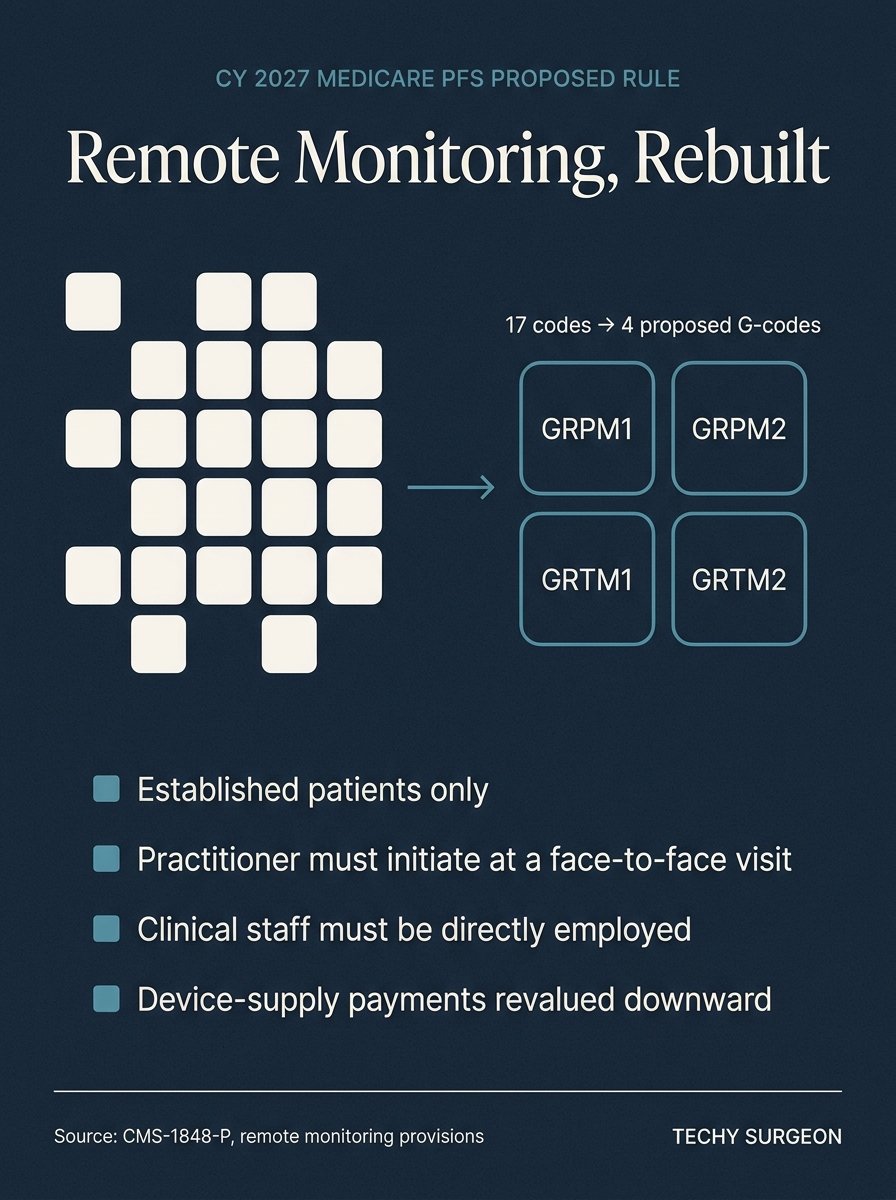
The most consequential section for digital health companies restructures remote physiologic monitoring (RPM) and remote therapeutic monitoring (RTM). Beginning in 2027, CMS proposes:1
- Established patients only. RTM joins RPM in requiring an established patient relationship before monitoring can begin.
- A required initiating visit. The billing practitioner must initiate RPM or RTM at a separately reportable face-to-face visit, in person or by telehealth.
- Direct employment of clinical staff. Clinical-staff time counts toward billing only when the staff member is a direct employee of the practitioner or the practice. Contracted third-party clinical staff would not qualify.
- Lower device-supply valuations. Device-supply and setup codes would be revalued using lower-cost crosswalks, and practice-expense inputs would be stripped from treatment-management codes.
CMS is also seeking comment on collapsing the seventeen existing remote-monitoring codes into four bundled monthly G-codes (GRPM1, GRPM2, GRTM1, GRTM2). Each management G-code would require the device supply, at least two days of data transmission, and at least twenty minutes of treatment-management time including a real-time interactive communication, all in the same calendar month. The agency cites OIG findings that 43% of enrollees receiving remote monitoring did not receive at least one of the three service components.5
The direct-employment requirement is the existential one. A large share of the RPM/RTM market sells a turnkey service: the vendor supplies the device, its own nurses do the monitoring, and the practice bills. Under this proposal that time no longer counts. The viable configurations narrow to software-and-device licensing where the practice's own staff furnish the service, staffing arrangements that make monitoring personnel bona fide employees of the practice, or repositioning monitoring as infrastructure for value-based programs where the revenue does not run through these codes at all. Vendors should also reprice the device line: if the final rule adopts the lower-cost crosswalks, passing hardware costs through at current Medicare rates stops working.
One more detail worth reading twice: the bundled G-codes would require a real-time interactive communication every billed month. Asynchronous-only monitoring programs, including many MSK RTM apps, would need a live-touch workflow to bill the management code as drafted.
The rest of this brief is for subscribers.
Below the line: how CMS is pricing your efficiency claims into the fee schedule, the new SaMS payment lane for algorithmic services, the ASM forced-adoption stack, the PRO-rails convergence map, the full exposure table (prior auth, price transparency, interoperability), and the operator checklist for the September comment deadlines. Members also get the RTM vendor-contract audit checklist, the 2027 impact calculator, and the CMS comment-letter template.