Most health tech operators will skim the CY 2027 Medicare proposed rules for their own billing codes and move on. That is a mistake. The Physician Fee Schedule rule (CMS-1848-P, released July 14, 2026)1 and the Hospital Outpatient/ASC rule (CMS-1850-P, published July 7)2 contain the clearest statement CMS has made about how it intends to pay for technology-enabled care: which delivery models it will fund, which staffing arrangements it will disqualify, which software categories get a payment lane, and whose efficiency gains it plans to capture. If your company sells into Medicare-billing providers, at least one section of these rules touches your revenue model. Comments are due September 14 (PFS)3 and August 31 (OPPS/ASC).4
Part 1 of this series covered the clinical-practice view, including the 7% orthopedic specialty impact and the joint-replacement revaluations. This part covers the vendor view. I write it wearing both hats: I operate as a surgeon inside these payment systems and I run a company, RevelAi Health, that builds care-navigation and outcomes infrastructure for musculoskeletal programs. Where a proposal touches our category, I say so.
1.Remote monitoring: the vendor-operated model is on notice
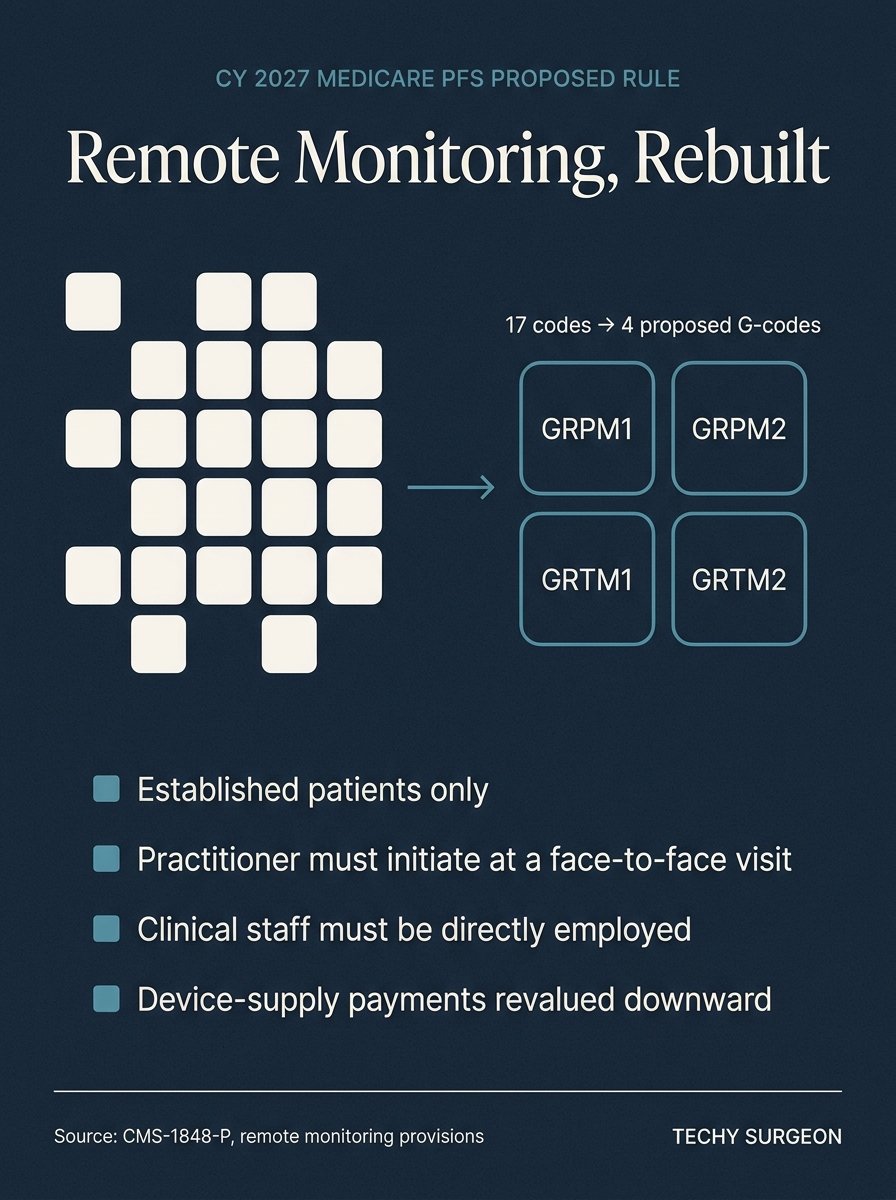
The most consequential section for digital health companies restructures remote physiologic monitoring (RPM) and remote therapeutic monitoring (RTM). Beginning in 2027, CMS proposes:1
- Established patients only. RTM joins RPM in requiring an established patient relationship before monitoring can begin.
- A required initiating visit. The billing practitioner must initiate RPM or RTM at a separately reportable face-to-face visit, in person or by telehealth.
- Direct employment of clinical staff. Clinical-staff time counts toward billing only when the staff member is a direct employee of the practitioner or the practice. Contracted third-party clinical staff would not qualify.
- Lower device-supply valuations. Device-supply and setup codes would be revalued using lower-cost crosswalks, and practice-expense inputs would be stripped from treatment-management codes.
CMS is also seeking comment on collapsing the seventeen existing remote-monitoring codes into four bundled monthly G-codes (GRPM1, GRPM2, GRTM1, GRTM2). Each management G-code would require the device supply, at least two days of data transmission, and at least twenty minutes of treatment-management time including a real-time interactive communication, all in the same calendar month. The agency cites OIG findings that 43% of enrollees receiving remote monitoring did not receive at least one of the three service components.5
The direct-employment requirement is the existential one. A large share of the RPM/RTM market sells a turnkey service: the vendor supplies the device, its own nurses do the monitoring, and the practice bills. Under this proposal that time no longer counts. The viable configurations narrow to software-and-device licensing where the practice's own staff furnish the service, staffing arrangements that make monitoring personnel bona fide employees of the practice, or repositioning monitoring as infrastructure for value-based programs where the revenue does not run through these codes at all. Vendors should also reprice the device line: if the final rule adopts the lower-cost crosswalks, passing hardware costs through at current Medicare rates stops working.
One more detail worth reading twice: the bundled G-codes would require a real-time interactive communication every billed month. Asynchronous-only monitoring programs, including many MSK RTM apps, would need a live-touch workflow to bill the management code as drafted.
Member edition · your working tools
This is the full brief, unlocked. Three tools built from this analysis, yours to use now:
2.CMS is pricing your efficiency claims into the fee schedule
In the CY 2026 final rule, CMS established an "efficiency adjustment" that cut the work RVUs of non-time-based services by 2.5%, to recur every three years, on the theory that technology and technique make procedures faster over time.1 The CY 2027 proposed rule goes further. In a comment solicitation on primary care and technology, CMS cites the adoption of ambient AI scribes and their measured effects on physician productivity,6 the growth of clinical AI tools, and the rise of AI-enabled patient-facing information, then asks how it should build "a comprehensive and consistent approach to payment for technology-enabled care given likely lower cost-to-serve."1
The ROI slide you show buyers is becoming CMS's evidence for paying those same buyers less.
This is the strategic bind for every efficiency-oriented vendor. Published time savings from your product category are now regulatory inputs: they justify efficiency adjustments, lower cost-to-serve assumptions, and eventually lower valuations for the services your customers bill. A payment system that captures the surplus your product creates erodes your customer's willingness to pay for it. The practical responses are to anchor value propositions in revenue integrity, capacity, and required reporting rather than raw minutes saved, and to participate in this RFI, because the valuation framework CMS builds here will outlast any single product cycle.
3.SaMS: Medicare is formalizing a payment lane for algorithmic services
On the hospital side, CMS proposes to rename the category it has called Software as a Service to Software as a Medical Service (SaMS), assign these services a new OPPS status indicator ("O1," separately payable), and hold their current new-technology APC payment levels for CY 2027 as an explicit interim step while it develops "a more comprehensive and appropriate payment methodology."2 The category today covers algorithm-driven diagnostics like quantitative coronary CT analysis, and the rule walks through several named products in assigning payment.
Two things follow. First, algorithmic clinical services now have a named, separately payable category in a major Medicare payment system, with a regulator openly designing its long-term pricing logic. If you build AI diagnostics or software-driven clinical analyses, the CY 2027 comment cycle is where the durable framework gets shaped; waiting for the final methodology means accepting terms others negotiated. Second, the direction of travel matters for adjacent categories. An agency that names and prices SaMS in the hospital setting, while simultaneously asking how AI changes physician work valuation in the office setting, is converging on a unified view of how software earns Medicare revenue. Companies should decide which lane they are in: a priced clinical service (SaMS), an input to clinician efficiency (captured by the efficiency adjustment), or infrastructure for mandatory measurement (section 5). Each lane has a different margin structure and a different regulatory posture.
4.The Ambulatory Specialty Model makes specialty analytics mandatory
The Ambulatory Specialty Model begins January 1, 2027: a mandatory five-year model that scores selected specialists treating low back pain and heart failure at the individual TIN/NPI level on quality, cost, improvement activities, and interoperability, with payment adjustments of −9% to +9% in the first two payment years rising to −12% to +12%.1 For 2027, CMS proposes adding a claims-based measure of potentially unnecessary lumbar MRI, adopting the Functional Outcome Assessment measure (Q182), a scoring incentive for voluntary patient-reported outcome submission, a rural scoring adjustment, and more flexible collaborative care arrangements with primary care practices.1
ASM is a forced-adoption event for a specific software stack: surgeon-level cost and quality analytics, functional-outcome and PRO collection, imaging-appropriateness decision support, and primary-care coordination tooling. The buyers are identifiable today (spine-heavy practices in the selected geographic areas), the deadline is statutory rather than discretionary, and the two-year lag between performance and payment means 2027 performance is already 2029 revenue. Vendors serving these practices have roughly six months to be implementation-ready. The same logic applies to the heart failure cohort for cardiology-adjacent products.
5.Outcome measurement is becoming mandatory rails
Set the individual programs side by side and a single infrastructure requirement emerges:
Disclosure is straightforward here: this is the category RevelAi Health builds in, so discount my enthusiasm accordingly. The observable facts stand on their own. CMS proposes to end traditional MIPS after the 2028 performance year and make MVP reporting mandatory in 2029.1 The joint-replacement MVP's proposed core measures are functional status and risk-standardized complications.1 ASM attaches a scoring incentive to voluntary PRO submission on its way to requiring it.1 TEAM already obligates hundreds of hospitals to collect THA/TKA patient-reported outcomes.7 For EHR, registry, and PRO vendors, the product requirement is convergence: one collection workflow that feeds MIPS/MVP, ASM, hospital quality reporting, and episode models simultaneously, with clinician-level attribution preserved throughout. Practices will not buy four parallel systems.
6.Payment plumbing that hits health tech P&Ls indirectly
| Proposal | Who feels it in health tech |
|---|---|
| Conversion factor down 1.19% (QP) / 1.68% (non-QP); orthopedic surgery −7%, with several other procedural specialties also negative1 | Everyone selling software to physician practices. Customer budgets tighten; ROI cases need hard dollars, not soft time savings. Forecast models that assumed flat Medicare professional revenue need rebasing. |
| Same-day E/M with modifier 25 paid at 50% alongside global procedures1 | RCM and coding-automation vendors: reduction logic, edit engines, and revenue forecasting all change. Scheduling-optimization products should note CMS' explicit warning against splitting visits across days to maximize payment. |
| Practice-expense overhaul: indirect-cost index removed, 5% annual stabilization cap, and a comment solicitation on whether hospital-employed physicians' facility-setting indirect PE allocation should fall from 50% toward 0%1 | Anyone whose market sizing assumes stable physician-office economics. The employed-physician PE question, if pursued, would further compress professional payment in hospital settings and accelerate site-of-service arbitrage. |
| Global-surgery data collection paused; CMS publishes work-RVUs-remaining file for 10- and 90-day globals1 | Documentation and care-coordination products for the postoperative period: the visits CMS believes are not happening are the ones your product should prove are happening, or replace. |
| OPPS +2.4%, ASC +2.4%, inpatient-only list eliminated by January 1, 2029, 618 codes proposed for the ASC covered list2 | Ambulatory-surgery tooling: episode navigation, remote recovery pathways, ASC operations software. The addressable outpatient surgical population keeps growing by regulation, on a published schedule. |
| OPD prior authorization expanded (eight botulinum-toxin codes, July 2027), continuing steady program growth since 20202 | Prior-auth automation and documentation vendors: Medicare FFS, historically light on prior auth, keeps adding categories. |
| RFI on standardizing hospital price transparency data2 | Price-transparency data companies: the usability of the machine-readable files is the product bottleneck, and CMS is asking how to fix the schema. Comment with specifics. |
| RFI on duplicate laboratory testing, imaging, and result sharing across care settings8 | Interoperability and imaging-exchange vendors: CMS is gathering the record for potential action on siloed results and duplicative testing. A documented deployment beats a position paper here. |
7.What health tech operators should do before September
First, map exposure code by code. If any revenue depends on the 17 remote-monitoring codes, model the proposed conditions of payment and the bundled G-code scenario separately. Know your number before the final rule publishes in November.
Second, re-paper what has to change. Staffing arrangements that route clinical monitoring through vendor-employed nurses need a compliant successor structure, and renegotiating after a final rule is a worse position than optioning it now.
Third, reposition ROI claims. Efficiency narratives are being metabolized into payment policy. Value cases built on capacity, required reporting, revenue integrity, and two-sided-risk performance age better than minutes saved.
Fourth, build for the rails. PRO and functional-outcome collection with clinician-level attribution is becoming a compliance requirement across MIPS, ASM, hospital quality programs, and episode models. Products that treat it as a feature will be replaced by products that treat it as the spine.
Fifth, comment, with data. CMS finalizes frameworks in the direction of the best-documented record it receives. The RTM consolidation, the SaMS methodology, the technology-enabled care RFI, and the price-transparency schema are all open questions this cycle. OPPS/ASC comments close August 31; PFS comments close September 14.3,4
Bottom line
The CY 2027 proposed rules treat technology-enabled care as a maturing category to be governed, priced, and in some cases disqualified, rather than a novelty to be encouraged. Remote monitoring gets conditions of payment that end the turnkey vendor model as commonly practiced. Algorithmic services get a named payment category with an interim price and an open methodology question. Specialty analytics and PRO collection shift from differentiators to mandates. And the efficiency your products create is being explicitly repriced into the fee schedule.
Companies that read these rules as compliance documents will spend the next year reacting. Companies that read them as a statement of what Medicare intends to buy will spend it building. I know which side we intend to be on.