BPCI Advanced Final Evaluation: The Surgeon Payment Question
BPCI Advanced saved Medicare about $800 million, and the mandatory joint replacement model saved another $180 million. The largest per-episode savings came from surgical care episodes. Why is CMS cutting the surgeons who helped it save money while maintaining quality?
Christian Péan, MD, MSOrthopaedic trauma surgeon · Duke · CEO, RevelAi HealthOctober 3, 2026
$822MBPCI Advanced net Medicare savings, 2018–2025
$180MCJR net Medicare savings, Oct 2021–Dec 2024
−$1,835per surgical episode in BPCI Advanced, 2021–2023 (−$756 medical)
41.5% → 25.8%surgical patients discharged to a post-acute facility
−28%CJR discharges to inpatient rehabilitation
1,010 → 105hospitals in BPCI Advanced, 2020 to 2025
CMS has released the final evaluation of the Bundled Payments for Care Improvement Advanced model, the largest voluntary episode payment test Medicare has run, and the evaluation of performance years 6 through 8 of the Comprehensive Care for Joint Replacement model, its mandatory counterpart for hip and knee replacement. BPCI Advanced alone covered more than 1,100 hospitals, 800 physician group practices and about 2.5 million hospital stays and procedures; CJR covered 321 hospitals and more than 143,000 joint replacements in its final three performance years.
Both reports reach the same conclusion. Episode accountability lowered Medicare spending without raising mortality or readmissions, and the savings came mostly from what happened after discharge. In BPCI Advanced, surgical episodes delivered the largest and most consistent reductions. Over the same period CMS has moved surgical episode risk to hospitals and proposed cuts to the work payment for the operations that produced those savings. This piece reads both reports with that tension in mind, lets you explore where the savings came from, and proposes what the next generation of models should pay surgeons for.
The two-minute version. Narrated by the author.
Interactive · Savings explorer
Where the savings came from, step by step through the 90-day episode
Scroll through the episode or tap any stop on the map. Switch models to compare surgical and medical episodes in BPCI Advanced with joint replacement in CJR. Every figure links back to the evaluation it came from.
Stop 1
Before surgery
Elective surgery gives the team weeks to prepare the patient. Participants described prehabilitation, joint classes, BMI and A1c optimization, and deferring high-risk cases until risk factors improved. Emergent medical admissions allow none of that.
Stop 2
Surgery and the hospital stay
Standardized service-line protocols, early ambulation, physical therapy and pain management. In CJR's final years two thirds of joint replacements were already outpatient.
Stop 3
Discharge destination
The decision that moved the most money. Participants adopted a "why not home?" default and used CMS claims data to see how often they sent patients to facilities compared with peers.
Stop 4
Inpatient rehabilitation
The most expensive post-acute setting, and the largest single source of savings for joint replacement. Hospitals that owned rehabilitation units had a reason to keep them full.
Stop 5
Skilled nursing
Fewer admissions and shorter stays. Participants built preferred networks of skilled nursing facilities, sent them care protocols, and in some cases rounded on their patients there.
Stop 6
Recovery at home
More patients went home, many with home health. This is also where patients registered the change: a small but consistent share said their discharge preferences were not taken into account.
Stop 7
Day 90: readmissions and quality
Neither model raised mortality or readmissions. Readmission rates fell in participant and comparison hospitals alike.
Stop 8
Reconciliation
Spending is compared with a target price and the difference is settled. Who kept the savings changed completely when CMS redesigned BPCI Advanced pricing in 2021.
Scroll to move through the episode, or tap any stop to jump to it.
Patient flow
Net Medicare savings by model period
BPCI Advanced participants reduced episode spending relative to their comparison group in every year. Medicare still lost money for the first three years, because CMS paid participants $1.24 billion in reconciliation against $1.06 billion in spending reductions. The model turned positive in 2021 after CMS added retrospective trend adjustments to target prices, aligned episode-overlap rules, and required participants to take whole service lines. From then on participants paid CMS a net $29 million while spending reductions continued, and the eight-year total came to $822 million (the report rounds to "about $800 million"). The firmest estimate covers 2021 to 2023, when the evaluators still had a matched comparison group: $915.8 million, with a 90% confidence interval of $745 million to $1.09 billion.
BPCI Advanced: net Medicare savings by model period, $ millions
Reduction in episode spendingNet reconciliation (down = paid to participants)Net savings
Source: BPCI Advanced Final Evaluation, Exhibits 5 and 6. Model Years 7–8 used a national comparison group, which the evaluators estimate overstates the effect by 13.6%.
CJR reached the same place by a different route. Its reconciliation also favored Medicare: across performance years 6 to 8, hospitals repaid $44 million more than they received, on top of $136 million in lower episode spending.
CJR: net Medicare savings, performance years 6–8 (October 2021 to December 2024)
$136Mreduction in joint replacement episode spending
+
$44Mnet repayments from hospitals to Medicare
=
$180Mnet Medicare savings across 321 hospitals in 34 metropolitan areas
Surgical episodes in BPCI Advanced saved Medicare money in every model year. From 2021 to 2023 the model reduced spending by $1,835 per surgical episode (5.9% of the baseline mean) and by $756 per medical episode (2.9%). Medical episodes were about three quarters of the evaluated sample, and before the 2021 redesign their reconciliation payments exceeded their spending reductions, which is where the early losses originated.
Change in Medicare spending per episode, surgical and medical
SurgicalMedicalModel Years 7–8, likely overstated
Difference-in-differences estimates, dollars per episode. Source: BPCI Advanced Final Evaluation, Exhibit 7.
The mechanism is familiar to anyone who has run a joint program. The share of surgical patients discharged to a skilled nursing or inpatient rehabilitation facility fell from 41.5% to 25.8%, about five points more than the comparison group, and patients who did go to a skilled nursing facility stayed 3.5 fewer days. In CJR, discharges to inpatient rehabilitation fell 28%, patients discharged home with home health rose 32%, and inpatient rehabilitation spending fell $443 per elective episode, which the evaluators identify as the main driver of savings.
"The BPCI Advanced data helped us realize we were overutilizers of [skilled nursing facilities] compared to others and below benchmarks in sending people home."BPCI Advanced hospital, Final Evaluation p. 17
Participation and target pricing
BPCI Advanced participation peaked at 1,010 hospitals and 728 physician group practices in 2020 and fell to 105 and 89 by 2025. The report gives three reasons. Service-line bundling forced participants to accept episodes they could not improve. Target prices were rebased on recent spending every year, so a group that became efficient early faced a lower target the next year. And surgical participants lost volume, both to ACO overlap rules and to ambulatory surgery centers, which took their healthier patients.
Participating hospitals and physician group practices by model year
HospitalsPhysician group practices
Source: BPCI Advanced Final Evaluation, Exhibit 3.
"You're fighting against yourself, right? Because eventually, you're going to drive yourself out of the program if you become too efficient."BPCI Advanced physician group practice, Final Evaluation p. 25
Physician groups were the surgical arm of the model: 57.8% of participating groups chose surgical episodes only, most often hip and knee replacement. When CMS softened terms in 2023 to slow attrition, it lowered the discount on medical episodes from 3% to 2% and left the surgical discount at 3%. Quality had little financial weight. On a $500-per-episode repayment, a participant at the 5th percentile of the composite quality score saved $13 and one at the 95th percentile saved $41.
Quality and patient experience
Neither evaluation found harm on claims-based measures. BPCI Advanced showed no effect on mortality and no significant change in 90-day readmissions as facility discharges fell. CJR found no adverse change in complications, mortality, unplanned readmissions or emergency department use, and both CJR and control hospitals cut readmissions and complications by more than 25% from baseline. One BPCI Advanced finding recurred in every survey wave: patients were 2.9 points less likely to say staff took their preferences for post-discharge care into account, and some described going home without the caregiver support they needed. I read that as a signal about shared decision-making and support at home, both of which surgeons and their teams shape in clinic weeks before discharge.
Surgeon payment since BPCI Advanced
TEAM began in January 2026 as a mandatory five-year model for 716 hospitals covering joint replacement, hip fracture, spinal fusion, CABG and major bowel surgery, with regional target prices and a 30-day post-discharge window. Under 42 CFR 512.505 only acute care hospitals are participants, and surgeons share in savings through arrangements the hospital chooses to offer. In July CMS announced CJR-X, a mandatory nationwide joint replacement bundle for most hospitals starting in January 2028, also hospital-held.
On the fee schedule, the 2026 final rule applied a 2.5% efficiency adjustment to the work RVUs of about 7,700 procedural codes and halved the facility-setting indirect practice expense tied to work RVUs. The 2027 proposed rule lowers the conversion factor to $32.84 for clinicians outside qualifying APMs and proposes 15.94 work RVUs for total knee arthroplasty and 15.37 for total hip, against 16.70 recommended by the RUC for both. I walked through those cuts in The $523 Knee Replacement and the CY 2027 fee schedule brief.
−$1,835Medicare spending reduction per surgical episode, BPCI Advanced, 2021–2023
≈ $523Proposed 2027 work payment for a total knee replacement (15.94 work RVUs × $32.84)
How the two payment systems interact
The Innovation Center and the physician fee schedule keep separate books. Episode savings flow to the Medicare trust fund. The fee schedule is budget neutral by statute, so an increase for office visits and primary care is paid for by reducing other services, and procedural work is the largest pool. A surgeon whose episodes cost $1,835 less receives no recognition when work RVUs are set, apart from a conversion factor about 1% higher for qualifying APM participants.
My interpretation, which the reports support but do not state, is that surgical efficiency is now recaptured twice. Bundle targets rebase on recent spending, so a group's own savings lower its next target, and the efficiency adjustment trims procedural RVUs on the premise that the work gets faster. Accountability for the episode has also moved. BPCI Advanced let surgeon groups hold risk directly, and they chose surgery. TEAM and CJR-X give it to hospitals, including hospitals that the BPCI Advanced evaluation found had competing incentives through ownership of rehabilitation facilities and home health agencies.
CMS has a serious case of its own. Budget neutrality is the law, and the agency cites time data showing shorter operative times. The voluntary model paid participants 117% of what they saved in its first three years, and CJR shows a mandatory hospital model can return money to Medicare from both sides of the ledger. Discharge planning and facility networks are hospital functions. Those points are fair, and none of them requires removing surgeons from episode accountability or leaving demonstrated savings unrecognized in how surgeons are paid.
What the next models should pay surgeons for
The savings in both evaluations came from the longitudinal parts of the episode: preparing patients before surgery, deciding where they recover, and following them home. Surgeons do much of that work inside a 90-day global package that pays one fixed fee regardless of what happens to post-acute spending. The proposals below would pay for that work directly and measure it.
1
Surgeon accountability for more of the longitudinal episode
BPCI Advanced showed that physician group practices will take downside risk on surgical episodes and deliver savings. TEAM and CJR-X should let qualified surgical groups initiate and hold episodes from the first visit through recovery, with hospital-held episodes as the default where no group elects to participate. Where the hospital holds the episode, CMS could set a minimum share of reconciliation for the attending group when savings are earned and quality thresholds are met.
The coordination work itself is unpaid today. A surgeon who manages a patient's transition home cannot bill transitional care management, because Medicare does not pay TCM when any of the 30-day period falls within that surgeon's global period. An episode-management payment for the surgical group, tied to discharge-to-home and 90-day outcomes, would fund the navigators and protocols that produced the savings.
2
Fee-for-service codes that follow the shift in site of service
Two thirds of CJR joint replacements were already outpatient in the final years, and CMS is phasing procedures off the inpatient-only list and onto the ASC covered procedures list. Michael C. Boblitz, CEO of Athens Orthopedic Clinic, proposed to CMS Administrator Dr. Mehmet Oz that physician payment rise "by 3% or more for qualifying orthopedic procedures performed in ambulatory surgery centers while remaining flat for the same procedures performed in hospitals." I support that design with two guardrails. The BPCI Advanced evaluation documents healthier patients shifting to surgery centers, so the incentive should come with public reporting of risk-adjusted 90-day outcomes, transfers and readmissions, plus the case mix of each surgeon's ASC patients by age, comorbidity, dual eligibility and ASA class. A practice whose case mix narrows sharply relative to its peers would see the differential reduced.
3
Payment for collecting patient-reported outcomes
Starting with the fiscal 2028 payment determination, a hospital's annual update under the Inpatient Quality Reporting program depends on submitting paired pre- and postoperative HOOS JR and KOOS JR surveys for the THA/TKA PRO-PM, with the follow-up survey due 300 to 425 days after surgery. In my experience that collection happens in the surgeon's clinic and follow-up calls, and no payment reaches the practice doing it. A per-patient payment for completed, paired PROMs, or a defined share of the hospital's quality incentive, would turn a reporting requirement into a funded clinical workflow and give surgeons outcome data they can act on.
4
A paid, measured handoff from surgeon to primary care
TEAM requires participant hospitals to refer patients to primary care. As written, the requirement comes with no payment and no measure of whether the patient was seen. A closed-loop handoff, with a completed primary care visit within a set window, the surgical plan and outcome data transmitted, and a modest payment to both the surgical and primary care practices when it happens, would make the referral real. Hip fracture is a TEAM episode, and the primary care visit after a fragility fracture is where secondary fracture prevention and bone health treatment begin, so a completed handoff affects the patient's risk of the next fracture, well beyond the episode itself.
5
Benchmarks that let efficient groups keep savings
Annual rebasing drove efficient groups out of BPCI Advanced. Fixing a participant's benchmark for three years, or blending its own history with a regional benchmark that moves slowly, would let early savings be retained long enough to justify the investment in care redesign.
6
Surgeons in model design and fee schedule recognition
Quality moved $28 per episode across the full range of performance in BPCI Advanced. Surgeons and specialty societies should help define episodes, risk adjustment and outcome measures so quality changes payment by a meaningful amount. Section 1115A also lets the Innovation Center waive payment rules to test a model, which CMS could use to exempt surgeons with sustained, risk-adjusted episode savings from the efficiency adjustment. That would connect the two ledgers without breaking budget neutrality in the base fee schedule. (I run RevelAi Health, which builds care coordination for these episodes, so I have a stake in the coordination and outcomes proposals.)
Independent practice and the next piece
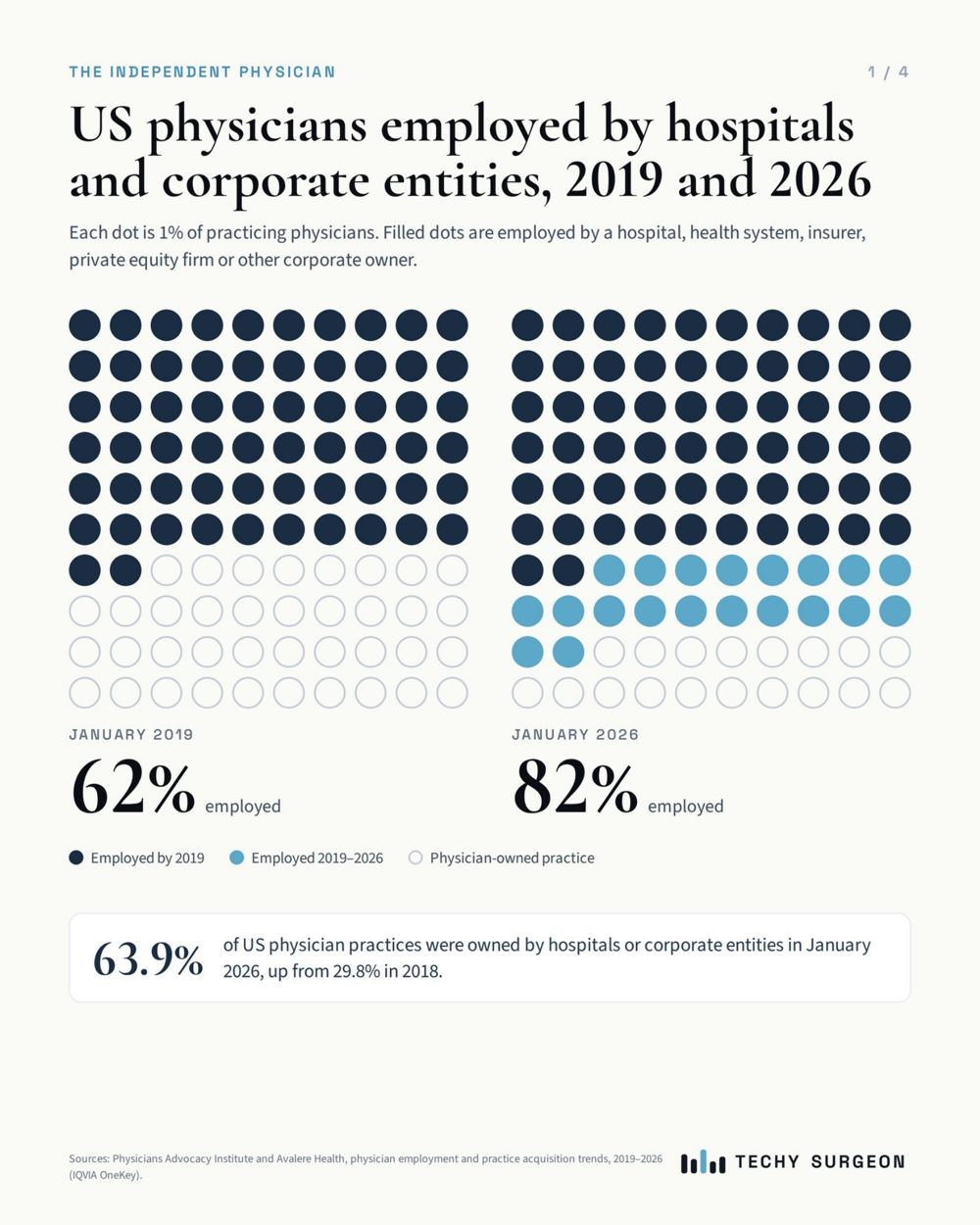
These policies reach a physician workforce that is changing fast. According to the Physicians Advocacy Institute and Avalere, 82% of US physicians were employed by hospitals or corporate entities in January 2026. Hospital-held bundles and procedural fee cuts push in the same direction, while site-neutral payment and the migration of surgery to ambulatory settings create an opening for independent groups that can prove value. I summarized those converging forces in a short carousel this week, and I'll take up the independent physician question in a separate piece on AI and value-based care as the levers for a more competitive, higher-quality market.
From "The Independent Physician" carousel, slide 1 of 4. Source: Physicians Advocacy Institute and Avalere Health (IQVIA OneKey).
BPCI Advanced and CJR answered the question they were built to test. Surgeons and hospitals can lower Medicare spending on episodes without harming patients, and surgical episodes did it most reliably. The next set of models should keep surgeons accountable for the whole episode and pay them in a way that reflects what they produced.
Get the policy brief in your inbox
Payment policy, clinical AI and surgical operations, written by a practicing surgeon. Free.
The Lewin Group. Bundled Payments for Care Improvement Advanced Model: Final Evaluation Report. Prepared for CMS, August 2026. CMS BPCI Advanced
CMS Innovation Center. Comprehensive Care for Joint Replacement Model, Findings at a Glance: Evaluation of Performance Years 6–8 (Oct. 2021–Dec. 2024). CMS CJR
Derived figures (net totals, shares of savings, the $523 work payment) are arithmetic on the cited exhibits. Educational content; not financial or legal advice.